

Vegan and Vegetarian Office Catering: Options and Costs 2026
1. Why vegan office catering is becoming the standard
Plant-based meals in the office are no longer a special order. In many teams, someone now sits at the table who eats vegan or vegetarian, out of conviction, for health reasons or out of religious consideration. An office catering that plans for these guests is not an extra service but part of a meal that includes everyone.
Three developments are driving this. Demand is rising because plant-based eating has long since reached the mainstream. Sustainability is moving into focus, and a high plant-based share measurably lowers the carbon footprint of workplace meals. And employer appeal plays its part, because a well-thought-out, varied food offer reads to younger professionals as a sign of appreciation. How meals fit in overall as a building block of employee retention is shown in our guide to employee catering for companies.
The switch is easier than expected because plant-based cooking has long moved beyond the plate of salad. Bowls, curries, filled dumplings, Mediterranean buffets and hearty bakes show that vegan and vegetarian fill you up and taste good, without a team feeling it has to go without.
2. Vegan, vegetarian, flexitarian: what reaches the table
Before prices and models come into play, a clean distinction between the terms helps, because it decides purchasing and labelling. Vegetarian includes dairy products and eggs but leaves out meat and fish. Vegan avoids all animal ingredients. Flexitarian describes no menu but a team that eats mostly plant-based and values meat as an occasional option. For the caterer, what counts above all is the clear labelling of every dish.
The options follow the format. Bowls combine a base of grains or legumes with vegetables, a plant protein such as tofu, chickpeas or edamame, and a dressing. Salad buffets offer variety with changing components and toppings. A warm lunch delivers curries, stews, roasted vegetables or filled pasta as the filling element. For finger food, vegetable skewers, falafel, wraps and dips work well when eaten standing up.
Two points round out a plant-based offer. The protein source should be visible, so the food fills you up and does not read as a side dish. And variety across the week keeps the same bowl from landing on the table every time. Which quality criteria count here is explored in our article on healthy employee catering.
3. What vegan office catering costs: does vegan cost more?
The most common worry when switching is the price. The result surprises many: plant-based office catering sits level with conventional in most formats, sometimes even below it. The reason lies in the ingredients, because vegetables, grains and legumes are cheaper than meat and fish. Only high-quality meat substitutes raise the price, and those can be used selectively.
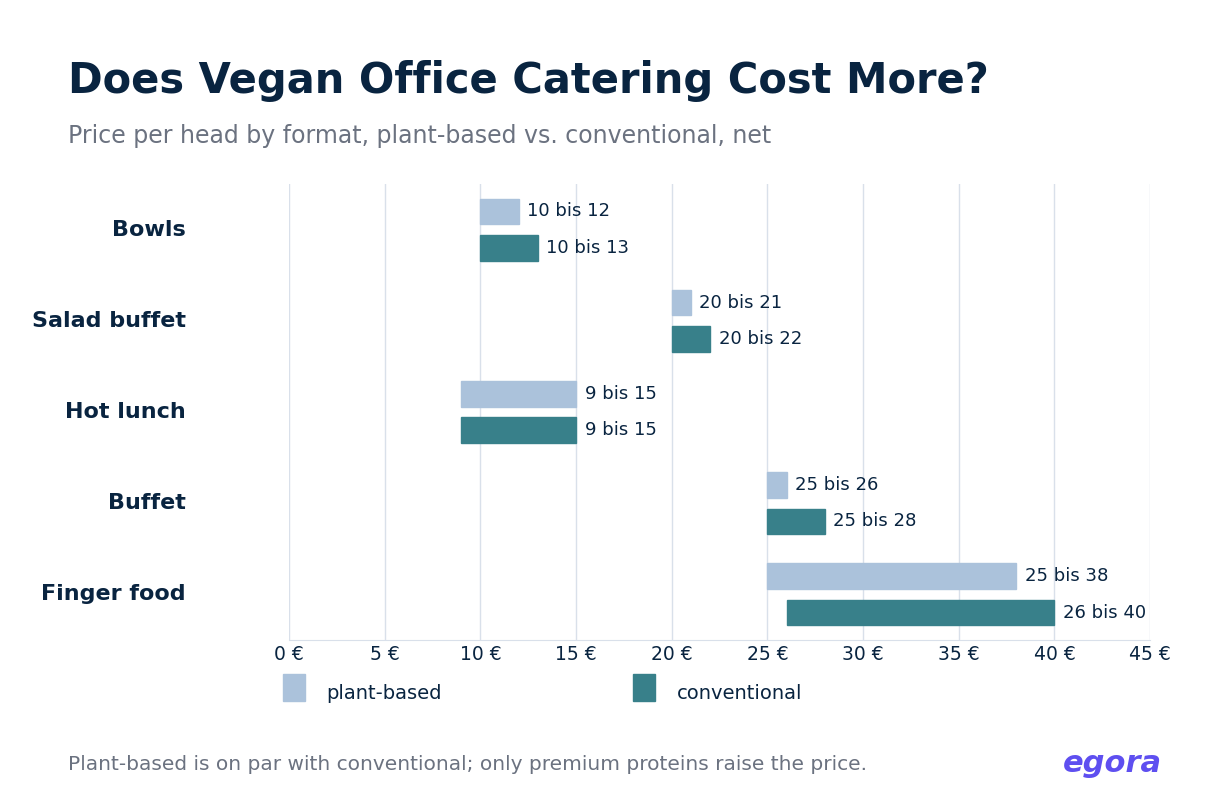
Figure 1: Does vegan office catering cost more? Price per head by format, plant-based against conventional, net. Bowls around 10 to 12 € plant-based, 10 to 13 € conventional. Salad buffet around 20 to 21 € against 20 to 22 €. Warm lunch 9 to 15 € in both variants. Buffet around 25 to 26 € against 25 to 28 €. Finger food around 25 to 38 € against 26 to 40 €. Plant-based sits level, only premium proteins drive the price.
In detail, the calculation looks like this: a plant-based bowl comes to around 10 to 12 € per head, a salad buffet around 20 to 21 €, a vegan or vegetarian buffet around 25 to 26 €. A warm vegan lunch moves within the general healthy daily average of 9 to 15 € per head. A warm vegan lunch at 12 € net comes to around 12.84 € gross for delivery alone at the reduced 7 percent rate; add service and the full rate applies.
The price gap to conventional catering stays small in almost all formats and only shifts upward once a lot of processed meat substitute reaches the table. Anyone who instead relies on natural protein sources such as legumes, tofu and tempeh keeps the price stable. How this fits into the overall budget is set out in our article on the budget per employee.
Request vegan office catering for your team
- Vegan and vegetarian options by format
- Price per head shown transparently
- Variety planned across the week
- Clear labelling of all dishes

4. Building the menu: fully vegan, mixed or a minimum share
Once the price question is settled, the practical one follows: how much plant-based should go on the buffet? Three models have taken hold, and which one fits depends on the team and its eating habits.
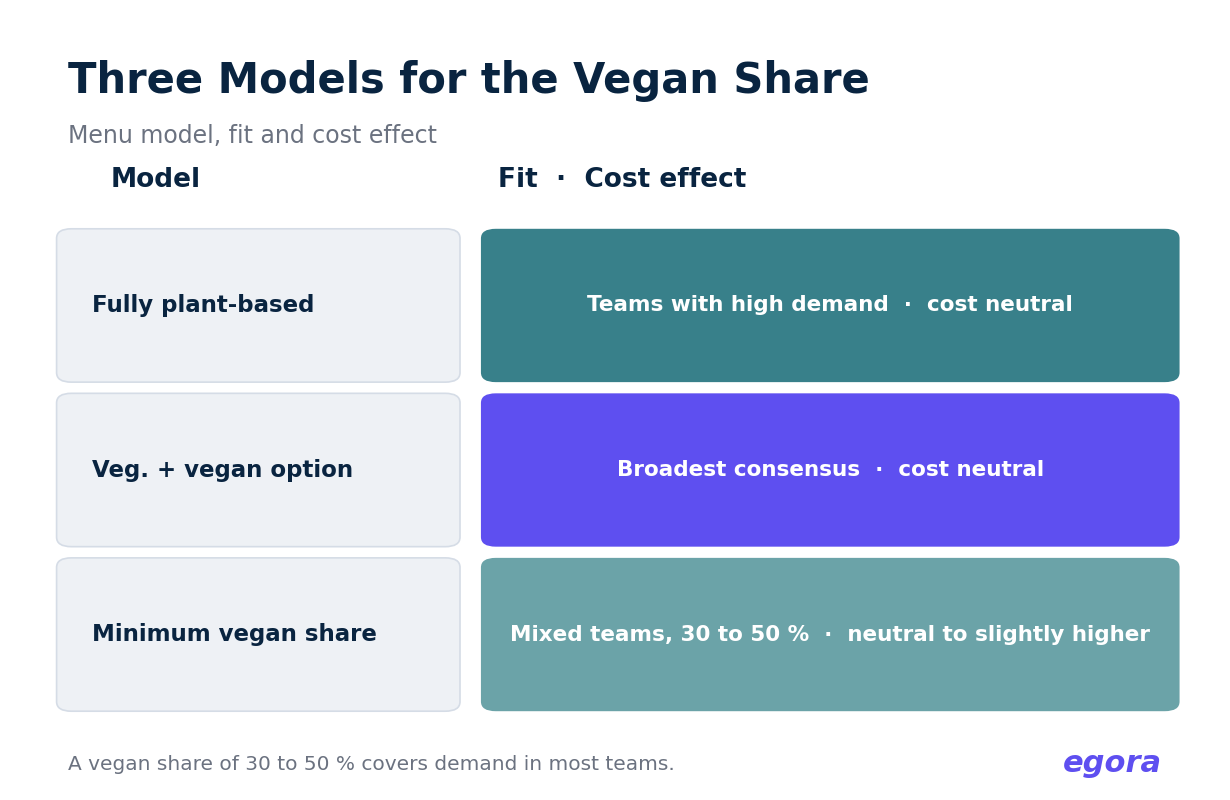
Figure 2: Three models for the vegan share. Fully plant-based suits teams with high demand, cost effect neutral. Mostly vegetarian with a vegan option brings the broadest consensus, cost effect neutral. A fixed vegan minimum share of 30 to 50 percent suits mixed teams, cost effect neutral to slightly higher. A share of 30 to 50 percent covers demand in most teams.
The fully plant-based model relies on a completely vegan buffet. It suits teams with high demand or firms that want to show sustainability clearly to the outside, and the cost effect stays neutral. The mixed model sets mostly vegetarian dishes alongside a clear vegan option and finds the broadest consensus, because no one is left out. Here too the price stays within the usual range.
The third model works with a fixed vegan minimum share in an otherwise mixed buffet. For most teams a share of 30 to 50 percent is enough to cover plant-based demand reliably without overlooking the meat eaters. The cost effect lands neutral to slightly higher if high-quality substitutes are added. This model suits mixed teams that want to bring in more plant-based food step by step. How office catering is set up by model and team in general is shown in our article on office catering for hybrid teams.
5. Quality and acceptance: what to look for in providers
A plant-based offer stands and falls on the execution. A carelessly assembled vegan buffet does more harm to acceptance than leaving it out entirely. Four points separate a good offer from a weak one.
Variety comes first: changing dishes across the week keep interest alive and prevent the same old bowl. Filling power follows directly, because without a visible protein source plant-based food is remembered as a starter rather than a full meal. The labelling has to be right, because allergens and the clear separation of vegan and vegetarian are not negotiable. And the taste is what convinces the sceptics in the end, which is why a test order before the standing arrangement pays off.
Acceptance within the team grows when no one feels something has been taken away. A plant-based offer that tastes good on its own merits convinces colleagues who otherwise reach for the meat. Which criteria make up high-quality meals, from freshness to nutritional balance, is set out in our article on healthy employee catering.
6. Rollout and financing in the daily office routine
From the concept to the routine, the day-to-day is what is missing: how often, in what form and financed how? This is where a good idea becomes an offer that holds.
The rhythm follows the office days. With two to three office days a week, an offer on exactly those days is enough, rather than planning through five. The form can rotate: bowls one day, a warm lunch the next, a salad buffet to round off the week. That way the variety stays and the order stays plannable.
The meal allowance helps with the financing. The tax-free allowance of 7.67 € per working day applies to plant-based catering just as it does to any other lunch and lowers the net cost for employer and team. How to use the allowance correctly is explained in our article on making the most of the meal allowance. For the concrete rollout in the office, our page on office catering provides the framework.
Have plant-based office catering planned
- Weekly plan with rotating formats
- Vegan share to suit the team
- Price per head and budget at a glance
- Meal allowance correctly factored in
Conclusion
Vegan and vegetarian office catering is not a question of a surcharge. In almost all formats it sits level with conventional catering, because plant-based base ingredients are cheap and only pricey meat substitutes raise the bill. Bowls at around 10 to 12 €, salad buffets at around 20 to 21 € and warm lunch options within 9 to 15 € per head cover the everyday.
The team decides the model when building the offer. Fully plant-based, mostly vegetarian with a vegan option, or a fixed vegan minimum share of 30 to 50 percent each bring a different degree of consensus. Set the vegan share at 30 to 50 percent, rotate the formats across the office days and factor in the meal allowance, and plant-based catering becomes a fixed part of office life that tastes good and fits the budget.
FAQ
Does vegan catering cost more than conventional?
In most formats, no. Plant-based base ingredients such as vegetables, grains and legumes are cheaper than meat and fish, so the price sits level or slightly below. Only high-quality meat substitutes raise the cost noticeably.
What does a vegan buffet cost per head?
A vegan or vegetarian buffet comes to around 25 to 26 € per head net. Smaller formats are cheaper: bowls around 10 to 12 €, a salad buffet around 20 to 21 €. A warm vegan lunch moves within 9 to 15 € per head.
How high should the vegan share be?
For most teams a vegan share of 30 to 50 percent on the buffet is enough to cover plant-based demand reliably. In teams with high demand or a clear sustainability focus, a fully plant-based offer can fit.
What are common vegan options for office catering?
Bowls with tofu or chickpeas, salad buffets with changing toppings, warm curries and roasted vegetables, plus finger food such as falafel, vegetable skewers and wraps. A visible protein source makes sure the food fills you up.
Is a fully vegan offer enough for the whole team?
That depends on the team. In groups with high plant-based demand, a fully vegan buffet works well. In mixed teams, a mostly vegetarian offer with a clear vegan option brings the broadest consensus, because no one is left out.
How do you finance vegan office catering through the meal allowance?
The tax-free meal allowance of 7.67 € per working day applies to every lunch, including plant-based catering. It lowers the net cost for employer and staff and combines easily with an office catering offer.
Similar articles




Get an individual menu suggestion today.