

Canteen, Catering, or Meal Allowance: What Actually Pays Off

1. Three models, three cost logics
Employee catering stopped being a perk a while ago. It's now a lever for retention and employer brand. The question is rarely whether to do it. It's how. And that's exactly where canteens, catering, and meal allowances split into three very different cost logics.
A canteen is an infrastructure project. You invest heavily once in a kitchen and staff, then drive down the price per meal. Catering is a service model with no fixed costs and a higher price per head. A meal allowance is a pure finance tool: no kitchen, no caterer, just a tax-advantaged amount your people spend wherever they like.
Put the three side by side and the differences jump out.
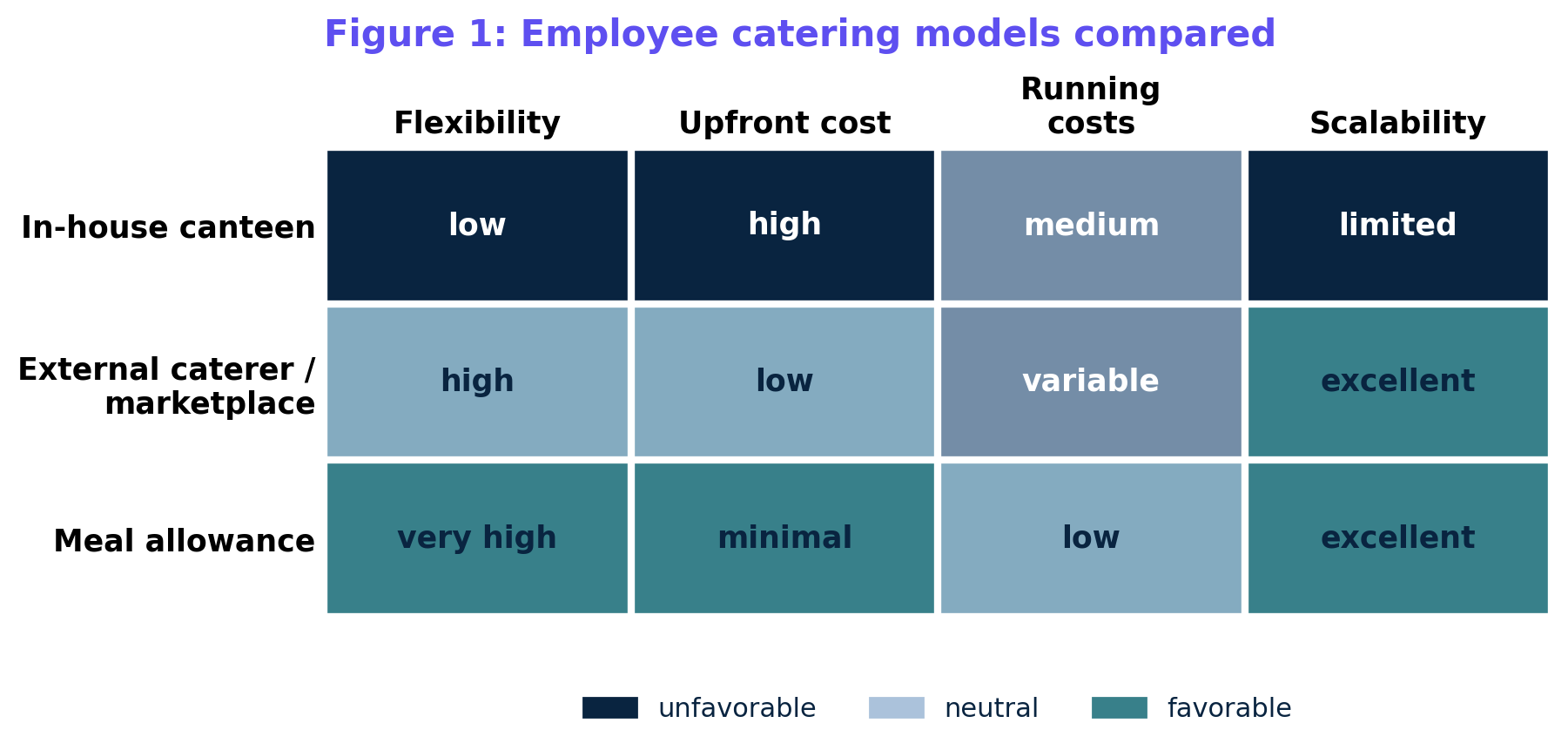
This is why large companies on a single site often run a canteen, while scale-ups with remote staff almost always land on an allowance. It isn't about better or worse. It's about fit. For the full picture, see our complete guide to employee catering.
2. What a canteen really costs
On paper, a canteen looks cheap. A single meal often runs just €3 to €6 in food cost. The catch is everything that happens before the first plate.
An in-house kitchen costs €150,000 to €400,000 to build, depending on fit-out and location. On top come €12,000 to €25,000 in fixed monthly costs for staff, energy, maintenance, and hygiene. Those costs hit whether 80 or 800 people show up.
That's the crux. A canteen only works when fixed costs spread across enough meals. At €18,000 a month over 20 working days, you need roughly 400 to 500 reliable diners a day to keep the subsidized price competitive. The moment attendance drops because of home office, the math tips over.
For most companies under 500 employees, a canteen is hard to justify financially. If you still want a hot lunch on site, predictable office catering usually comes out cheaper, because the fixed-cost trap disappears.
A meal program built around your team

3. Catering through a marketplace: flexible and predictable
Catering flips the canteen logic. You pay nothing upfront and no fixed costs, just a clear price per person. Depending on format, that runs from €8 for a simple bowl delivery to €25 for a multi-course team lunch.
The big win is predictability. You book exactly the days and headcount you need. Attendance spikes one week, you order more. A day falls through, you pay nothing. That flexibility makes catering the default for companies of 20 to 500 people.
A marketplace sharpens the advantage. Instead of locking into one house caterer, you compare vetted providers, rotate menus, and keep an eye on prices. For how the per-head cost breaks down, see our guide to catering costs for companies.
One real snag for small teams is the order minimum. Book for 12 people and you often pay more per head than a 60-person office does. Our piece on catering minimum orders shows how to work around it.
4. Meal allowance 2026: the tax lever
A meal allowance gives you the best ratio of effort to impact. Instead of organizing food, you hand your team an amount they spend themselves, at the supermarket, with a delivery service, or at the restaurant next door.
The 2026 tax rules make it attractive. Up to €7.67 per working day is tax-advantaged. That figure comes from two parts: the official benefit-in-kind value of €4.57 and a tax-free employer top-up of €3.10. The benefit-in-kind portion carries a flat 25% tax, and social contributions drop away entirely when it's set up correctly.
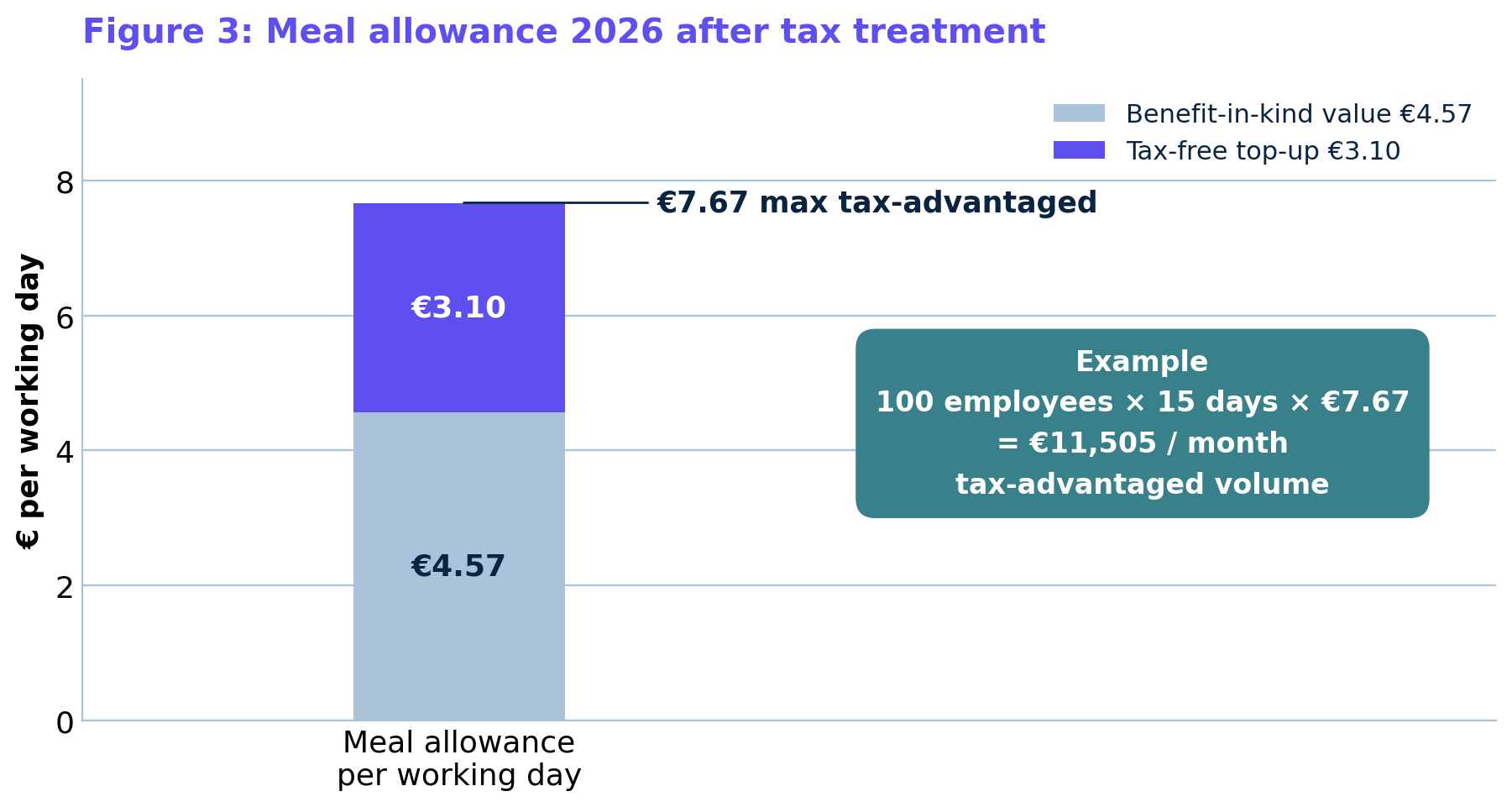
The example makes the scale concrete. With 100 employees using the full rate on 15 days a month, you reach a tax-advantaged volume of €11,505 a month (100 employees × 15 days × €7.67).
Most of that flows tax-advantaged, lands net with your people, and costs you no infrastructure. That's why the allowance is often the most economical choice for hybrid and distributed teams. Our employee catering guide digs deeper into the tax detail.
5. Cost compared by company size
Theory is fine. Numbers are better. Here's what running food provision costs per employee, by size and frequency.

These ranges apply to catering and allowance models, where you pay variably. A canteen has a different cost profile, because fixed costs dominate. So the decisive comparison isn't just price per head. It's the structure underneath.
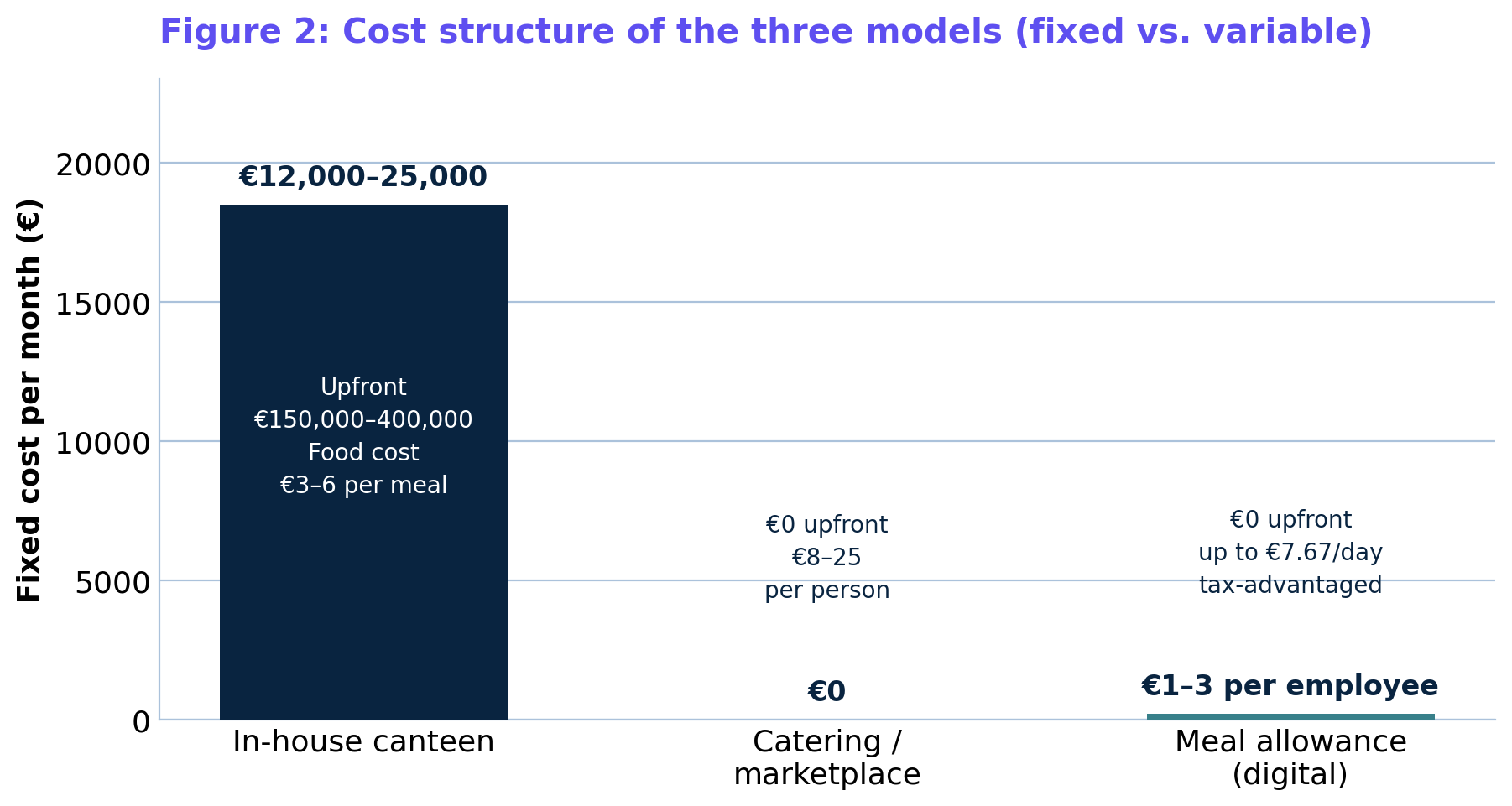
The pattern is clear. The more reliable diners on a fixed site, the sooner a canteen carries its fixed costs. The more distributed and variable your team, the more catering and an allowance pull ahead. For showcase occasions and larger company formats, it's also worth a look at dedicated business catering.
6. Which model fits your company?
The decision boils down to a few factors: attendance, site structure, and the flexibility you want. The matrix below gives you a clear steer.
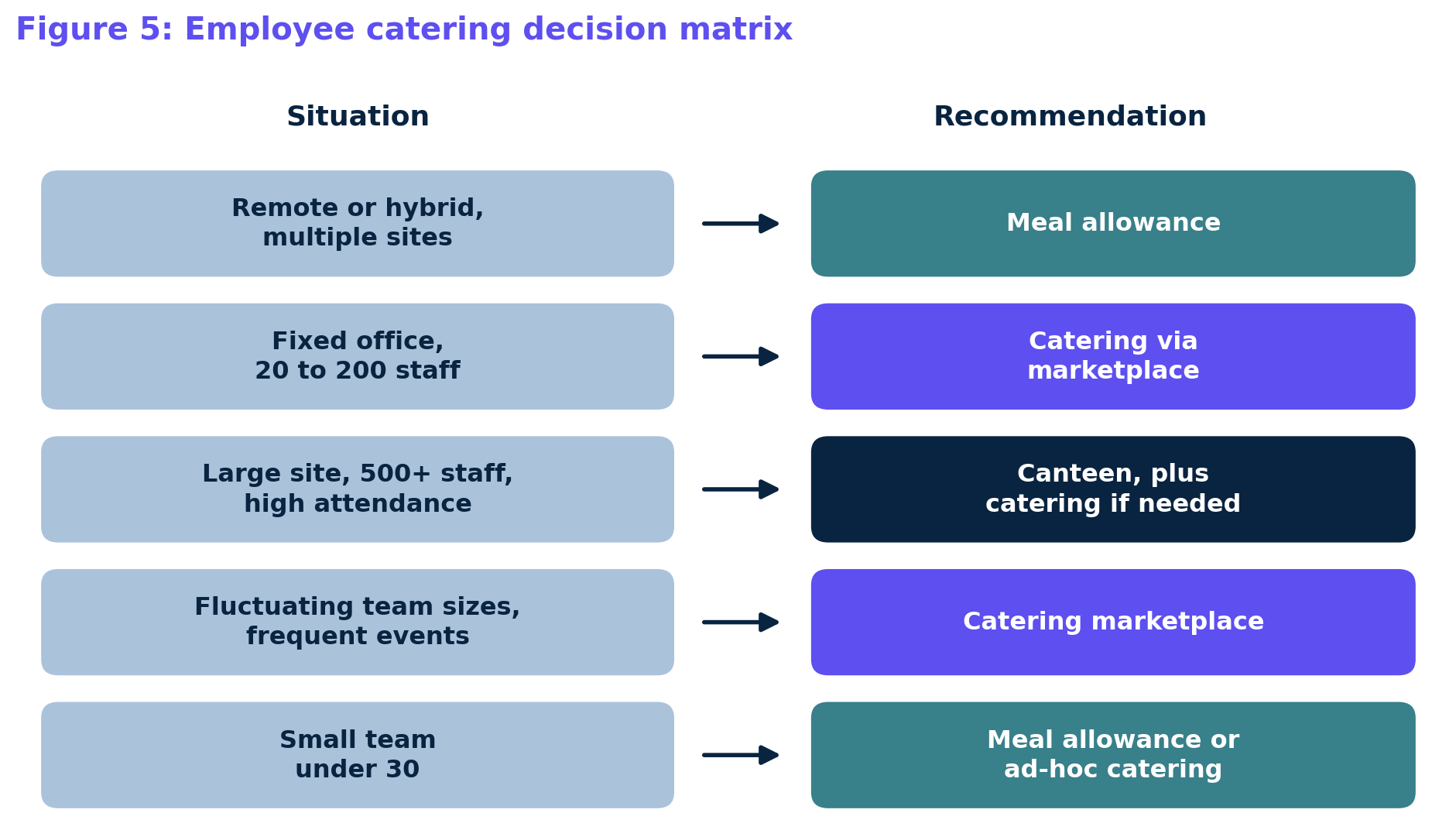
In practice, blends often win. A company with a main office and remote staff might pair weekly office catering with a meal allowance for everyone working from home. Each group gets the right offer, and no single model gets stretched too far.
The key is to run the math honestly. A canteen at 40% utilization costs more than any catering. And an allowance that stays below the tax-advantaged maximum leaves money on the table. If you're unsure, model the three scenarios cleanly before anyone signs a contract.
Get a free needs assessment
The bottom line
No model wins every time. A canteen shines at very large, high-attendance sites, but breaks down on its fixed costs the moment utilization wobbles. Catering wins for the broad middle, companies of 20 to 500, thanks to zero upfront cost and full predictability. A meal allowance wins wherever teams are spread out and you use the €7.67-a-day tax lever in full.
So the honest answer to what actually pays off is simple: do the math instead of guessing. Lay attendance, upfront cost, and per-head price side by side, and in five minutes you'll see which way to go.
FAQ
How many employees do you need before a canteen pays off?
As a rule of thumb, an in-house canteen needs around 400 to 500 reliable diners a day to cover €12,000 to €25,000 in monthly fixed costs. That usually means a site of 500-plus employees with high attendance. Below that, catering or an allowance is generally cheaper.
How high is the meal allowance in 2026?
Up to €7.67 per working day is tax-advantaged. The figure combines a benefit-in-kind value of €4.57 and a tax-free employer top-up of €3.10. The benefit-in-kind portion carries a flat 25% tax, and social contributions don't apply.
What does employee catering cost per month?
Depending on frequency, expect €60 (once a week) to €360 (daily) per employee per month. Over a year, that's €720 to €4,320 per person. The exact figure depends on the format and the model you choose.
Is catering or a meal allowance more flexible?
Both beat a canteen on flexibility. A meal allowance is the most flexible, since it works anywhere, including home office. Catering is flexible on quantity and menu but tied to a delivery location. For hybrid teams, a combination of the two often makes sense.
Can I combine the models?
Yes, and in practice it's often the most economical setup. Many companies pair weekly office catering for in-office days with a meal allowance for remote staff. Each group gets a fitting offer, and no single model gets overloaded.
Who helps choose the right model?
A catering marketplace like eGora compares providers, checks the tax angles, and builds a realistic budget for your company size. So you can work out which way pays off before you commit to any contract.