


Healthy Employee Catering: Criteria, Weekly Plan and Budget 2026

1. Why healthy employee catering pays off
Healthy employee catering has long since stopped being a pure feel-good topic and become a lever that pays into concentration, mood and retention. Eat a balanced lunch instead of a heavy, sugary one and you fall into the familiar afternoon slump less often, staying more capable across the day. That is not a cure claim but everyday experience in many teams: a light, fresh meal sits differently than the quick currywurst around the corner.
For employers, attractiveness as an employer is added. A well-considered, visibly healthy catering offer is a concrete benefit that lands in everyday working life every single day, unlike many promises from the job interview. It signals appreciation, makes a shared team lunch easier and is expected especially by younger professionals. In a tight labour market that argument works out cheaper than it costs.
The right framing helps here. Healthy catering is one building block of the overall employee provision, not an isolated project. How it fits into the bigger picture, from frequency through models to tax, is shown by our complete guide to employee catering. This article focuses on the quality question: what makes catering healthy, what a practical weekly plan looks like and what it costs per head.
It is on budget that the sober look pays off. Healthy does not have to be expensive, but it needs planning. To learn what per-head sum to expect per month and year, see the basics in our article on the budget per employee. Up front: the healthy variant almost always sits in the same corridor as the unhealthy one, because vegetables, whole grains and pulses are cheap fillers.
2. What "healthy" concretely means: the criteria
Healthy is a stretchy term, which is why it is worth pinning it to a few clear criteria. The principles of a balanced diet, as described for instance by the German Nutrition Society, serve as direction. From these, five practical criteria can be derived against which any office catering can be measured, without it becoming complicated.

Figure 1: Criteria of healthy employee catering. First, plant-forward and lightly processed, with plenty of vegetables, salad and whole grains. Second, enough protein from pulses, eggs, fish or lean meat. Third, less sugar and less heavily processed food instead of ready-made sauces and sweet snacks. Fourth, visible vegetarian, vegan and allergen-friendly options. Fifth, fresh and seasonal with short routes. Each criterion with a short what-to-watch-for note.
The first and most important criterion is a high share of plant-based and lightly processed components. Plenty of vegetables, salad, whole grains and pulses should fill the plate, not play the side. A colourful bowl, a well-stocked salad buffet or a vegetable pan with whole-grain rice meet this almost by themselves. What to watch for: vegetables should be visible and present in quantity, not just decoration on the rim of the plate.
The second criterion is enough protein, because it satisfies and stabilises blood sugar across the afternoon. Good sources are pulses such as chickpeas and lentils, eggs, fish, tofu or lean meat. Healthy catering does not have to be meat-heavy, on the contrary, it cleverly combines plant and animal protein. What to watch for: every main component needs a clear protein source, otherwise the satiety does not last long.
The third criterion is less sugar and less heavily processed food. Ready-made sauces, breaded convenience products and sweet snacks are the typical hidden calorie sources. Healthy here does not mean going without but balance: a homemade dressing instead of the ready sauce, water and unsweetened tea as the standard, fruit instead of a chocolate bar at the snack station. What to watch for: the default should be unsweetened, the sweet stays the exception.
The fourth criterion is visible vegetarian, vegan and allergen-friendly options. Healthy catering excludes no one. A full vegan main component, clear labelling of the most common allergens and a lactose- or gluten-free alternative belong to the standard today. What to watch for: the options must be attractive and equal, not the joyless side plate for those who do not eat meat.
The fifth criterion is freshness and season. Freshly prepared, ideally seasonal and regional ingredients taste better, contain more nutrients and often come with shorter routes. A rotating menu that follows the course of the year also creates variety and prevents the monotony that costs acceptance. What to watch for: a provider with a seasonally changing menu is usually a better sign than an always identical standard selection.
3. The healthy office weekly plan: a practical example
Criteria are the theory, the weekly plan is the practice. A good plan mixes the formats so that variety arises across the week, the budget stays within reach and no one gets bored. Treat what follows as an example that adapts to your own team size, presence rate and kitchen. The pattern works for many small to mid-sized offices.
Monday starts warm and uncomplicated with a balanced lunch dish, for example a vegetable pan with whole-grain rice or a lentil dal with naan and salad. A single warm lunch dish lands at around 7.81 € per person and is thus the cheap anchor of the week. It delivers protein and vegetables on one plate and is a reliable filler after the start of the week.
Tuesday is the bowl and salad day. Colourful bowls with quinoa, roasted vegetables, chickpeas and a fresh dressing, or well-composed pasta-salad bowls, hit exactly the nerve of a light, modern lunch break. Such bowls land at around 10.70 € per person, single salads much cheaper at about 4 to 5 €. Tuesday is thus the healthiest and at the same time most popular day, because it is both fresh and filling.
Mid-week on Wednesday is well suited to a buffet day that builds community. A light salad or lunch buffet that everyone assembles themselves creates shared eating in the team and covers different preferences in a single setup. Such a buffet starts at about 15 € per person, a full salad buffet lands at around 19.80 to 21.29 €. The buffet day is the social highlight of the week.
Thursday may again turn out light and lean, for example with a soup plus a whole-grain sandwich or a reduced bowl selection. That keeps the weekly budget in balance without quality suffering. Friday, finally, can offer a slightly larger warm dish or a small highlight to round off the week, depending on presence and mood in the team.
Over all of this sits the base provision that applies every day: a snack and fruit station with fresh fruit, nuts and yoghurt as well as a drinks base with water, unsweetened tea and coffee. These defaults often decide more about perceived health than the main dish, because they are available all day. How often warm catering per week is worth it at all is set out in our article on how much catering per week makes sense.
Request a healthy weekly plan for the office
- Weekly mix of warm lunch, bowls and buffet
- Vegetarian, vegan and allergen-friendly options included
- Per-head budget calculated transparently
- Suitable providers from Berlin and Munich

4. Format and frequency: implementing healthy without extra effort
Catering healthily rarely fails on willingness, more often on organisational effort. Helpfully, the question of the right model and the right frequency can largely be solved independently of the health question. Healthy food fits into every provision model, from daily lunch catering to flexible delivery on presence days.
Which delivery and provision model fits your team depends mainly on the way of working. For hybrid teams with fluctuating presence there are dedicated models, which we explain in detail in our article on office catering for hybrid teams. We deliberately do not repeat the model overview here but hold this: the health criteria apply regardless of whether delivery is daily, on fixed days or on demand.
Frequency is also a question of its own. How many warm lunch days per week make sense depends on presence, budget and acceptance and not on how healthy the food is. The profile question of whether catering pays off at two or five presence days is handled separately in our article on 2 vs. 5 presence days. For the healthy weekly plan the guideline is: better to cater really well and freshly on three days than joylessly on five.
A practical lever for healthy variety is a high share of vegetarian and vegan dishes. Plant-forward cuisine meets the most important health criteria almost automatically and tends to cost less in procurement. Choose the provider cleverly here, look for a broad plant-based range, and you get health and variety without extra effort. The right office catering can be flexibly aligned to healthy priorities.
5. What healthy catering costs: budget per employee
The central question remains the budget. Helpfully, healthy catering sits in the same corridor as conventional, because vegetables, whole grains and pulses are cheap and at the same time high-quality fillers. The deciding factor is less the individual dish than the clever mix across the week.
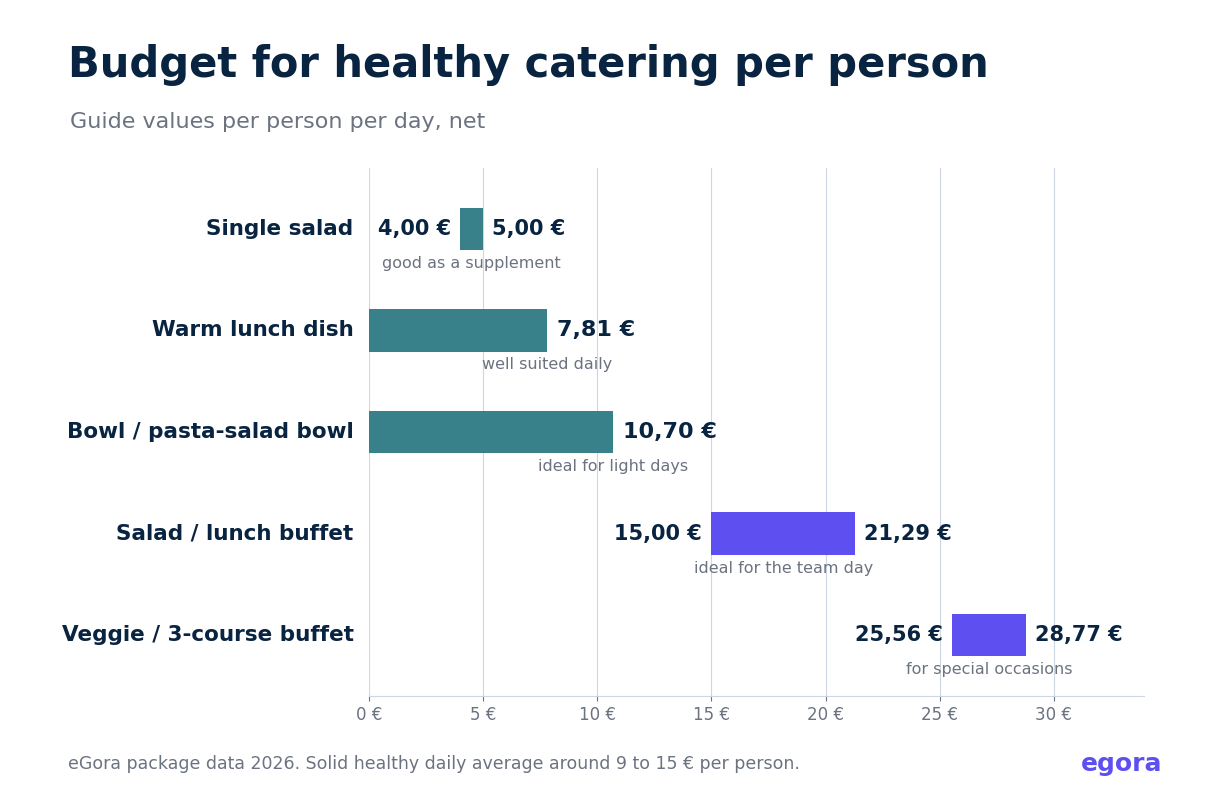
Figure 2: Budget and weekly-mix matrix, guide values per person per day. Warm lunch dish around 7.81 €, well suited daily. Bowls and pasta-salad bowls around 10.70 €, ideal for light days. Single salads around 4 to 5 €, good as a supplement. Salad and lunch buffet from around 15 €, eGora salad buffet around 19.80 to 21.29 €, ideal for the team day. Two-course veggie buffet around 25.56 €, three-course buffet around 28.77 €, for special occasions. Solid healthy daily average around 9 to 15 € per person.
The most important corridor for everyday use lands at around 9 to 15 € per person per day for a solid, healthy lunch solution. Within this frame, warm dishes, bowls and the occasional buffet can be combined so that a balanced average arises across the week. A single warm lunch dish is the cheap anchor at around 7.81 €, bowls land at around 10.70 €, single salads at about 4 to 5 € per person.
For the buffet day, separate values apply. A light salad or lunch buffet starts at about 15 € per person, a full eGora salad buffet lands at around 19.80 to 21.29 €. For something more premium on special occasions, a two-course veggie or vegan buffet runs around 25.56 € and a three-course buffet around 28.77 € per person. How the formats are calculated in principle is shown by our buffet catering page.
With team size, the budget scales largely linearly on the food, while delivery and base effort distribute across more heads. For a team of twenty people with three healthy lunch days per week, you land, depending on the mix, at a manageable weekly budget that can be planned clearly. The monthly and annual projection per head is shown in detail by our article on the budget per employee.
6. Financing and tax: using the meal allowance cleverly
A substantial part of the budget can be financed with tax support, namely via the meal allowance. The state allows employers to grant employees a subsidy towards the meal that stays free of tax and social contributions up to a fixed limit per working day. In 2026 this maximum amount lands at around 7.67 € per working day. A healthy warm lunch or a bowl moves in exactly this order of magnitude.
In practice this means: a substantial part of the healthy catering can be co-financed via the tax-free subsidy, so that the effective burden on the company falls and at the same time more reaches the employee than with classic gross pay. This often makes the healthy variant cheaper than the pure per-head figure suggests. The mechanics in detail, from the conditions to correct accounting, are explained in our article on how to use the meal allowance optimally.
We deliberately do not re-derive the tax subtleties here. The core idea holds: anyone investing in healthy catering should factor in the subsidy from the start. It turns a cost factor into a tax-optimised benefit and noticeably improves the ratio of effort to effect. For ongoing provision, the right corporate catering can be combined with the subsidy logic.
7. Implementation in practice: defaults, acceptance, choosing a provider
Implementation decides whether the criteria become lived practice. The most effective lever is healthy defaults. What is visible, well placed and easily reachable gets eaten. Put the water and the fruit at the front and the sweet snack at the back, and behaviour shifts entirely without bans. Healthy catering works best when the healthy choice is the convenient choice.
A second pillar is acceptance in the team. Healthy is no use if it does not taste good and no one takes it. A short, regular feedback, for instance via a quick survey or a chat in the break, shows which dishes land and which stay in the pot. Shape the selection with the team rather than over their heads, and acceptance climbs while expensive leftovers fall away. Variety across the week and across the season keeps the enthusiasm alive.
The third pillar is the choice of provider. Not every caterer is set up for healthy, plant-forward and seasonal cuisine. Look for a broad vegetarian and vegan range, clear allergen labelling, a seasonally changing menu and the willingness to adapt a weekly plan flexibly. A good provider builds in the health criteria rather than treating them as a special request. Where such catering fits into office routine is shown by our office catering overview.
A no-obligation estimate for healthy employee catering
- Weekly plan according to health criteria
- Vegetarian, vegan and allergen-friendly options
- Per-head budget calculated including the meal allowance
- Result within a few hours

Conclusion
Healthy employee catering works best when clear criteria, a practical weekly plan and a realistic budget come together. Healthy means plant-forward and lightly processed, with enough protein, little sugar, visible vegetarian, vegan and allergen-friendly options as well as fresh, seasonal ingredients. These five criteria are easier to implement than they sound, because a good mix of warm lunch, bowls and salad buffet meets them almost by itself.
A sober look at the budget is the second pillar. A solid healthy lunch solution lands at around 9 to 15 € per person per day, a light buffet starts at about 15 €, and a substantial part of it can be co-financed via the tax-free meal allowance. Add healthy defaults, feedback from the team and a suitable provider, and every euro spent goes noticeably further, entirely without fruit-basket symbolism.
FAQ
What makes employee catering healthy?
Healthy is catering that meets five criteria: a high share of plant-based and lightly processed components, enough protein from pulses, eggs, fish or lean meat, little sugar and heavily processed food, visible vegetarian, vegan and allergen-friendly options as well as fresh, ideally seasonal ingredients. A good mix of warm lunch, bowls and salad buffet meets this almost by itself.
What does a healthy office lunch cost per person?
A solid healthy lunch solution lands at around 9 to 15 € per person per day. A single warm lunch dish costs around 7.81 €, bowls land at around 10.70 €, single salads at about 4 to 5 €. A light salad or lunch buffet starts at about 15 €, a full eGora salad buffet at around 19.80 to 21.29 € per person.
What does a healthy weekly plan for the office look like?
A practical plan mixes the formats: a warm lunch dish to start the week, a bowl and salad day, a buffet day mid-week for shared eating, a light day with soup or a reduced selection and a flexible Friday. Over this sits a daily base provision with fruit, nuts, water and unsweetened tea.
How often per week should catering be healthy?
That depends on presence, budget and acceptance, not on the health question itself. It is often sensible to cater really well and freshly on three days rather than joylessly on five. How many lunch days per week fit is handled separately in our article on how much catering per week makes sense.
Does the meal allowance cover the costs?
A substantial part. The tax-free meal allowance stays free of tax and social contributions up to around 7.67 € per working day in 2026 and thus sits exactly in the order of magnitude of a healthy lunch. With it, a good part of the catering can be co-financed. The details are explained in our article on the meal allowance.
How do I get vegetarian, vegan and allergen-friendly options?
Through the choice of provider. Look for a broad vegetarian and vegan range, clear allergen labelling, a seasonally changing menu and the willingness to adapt the weekly plan. A good provider builds these options in as standard and offers them on equal terms, not as a joyless side plate.
Similar articles




Get an individual menu suggestion today.