

Office Catering for Hybrid Teams: Models and Costs Explained

1. Why hybrid teams need their own catering model
Office catering for hybrid teams isn't a shrunken canteen model; it follows its own logic. Someone working three days in the office and two days from home needs something different each day.
The core problem is fluctuating attendance. A fixed daily catering order for everyone means paid food on remote days that nobody calls up. Conversely, a purely remote logic leaves the office days unused, the very days where shared meals have the biggest effect on team and culture.
On top of that comes planning uncertainty. How many people are actually in the office on Tuesday varies week to week. A good model has to absorb this uncertainty rather than paper over it with flat rates.
For a hybrid team, catering does more than fill stomachs. It's one of the few levers that makes an office day concretely more attractive than the kitchen table at home. If you want to encourage presence without mandating it, a shared lunch gives people a solid reason to come in. That is the starting point for the three models below. For the strategic picture, see our complete guide to employee catering.
2. Model 1: On-site catering on fixed office days
The first model concentrates catering on the days when most people are in anyway. Instead of offering something every day, a caterer delivers specifically on fixed office days.
The advantage is predictability. Set Tuesday and Thursday as office days, and you can estimate demand well and place firm orders with the caterer. The shared lunch becomes an anchor that makes presence attractive and connects the commute with a concrete benefit.
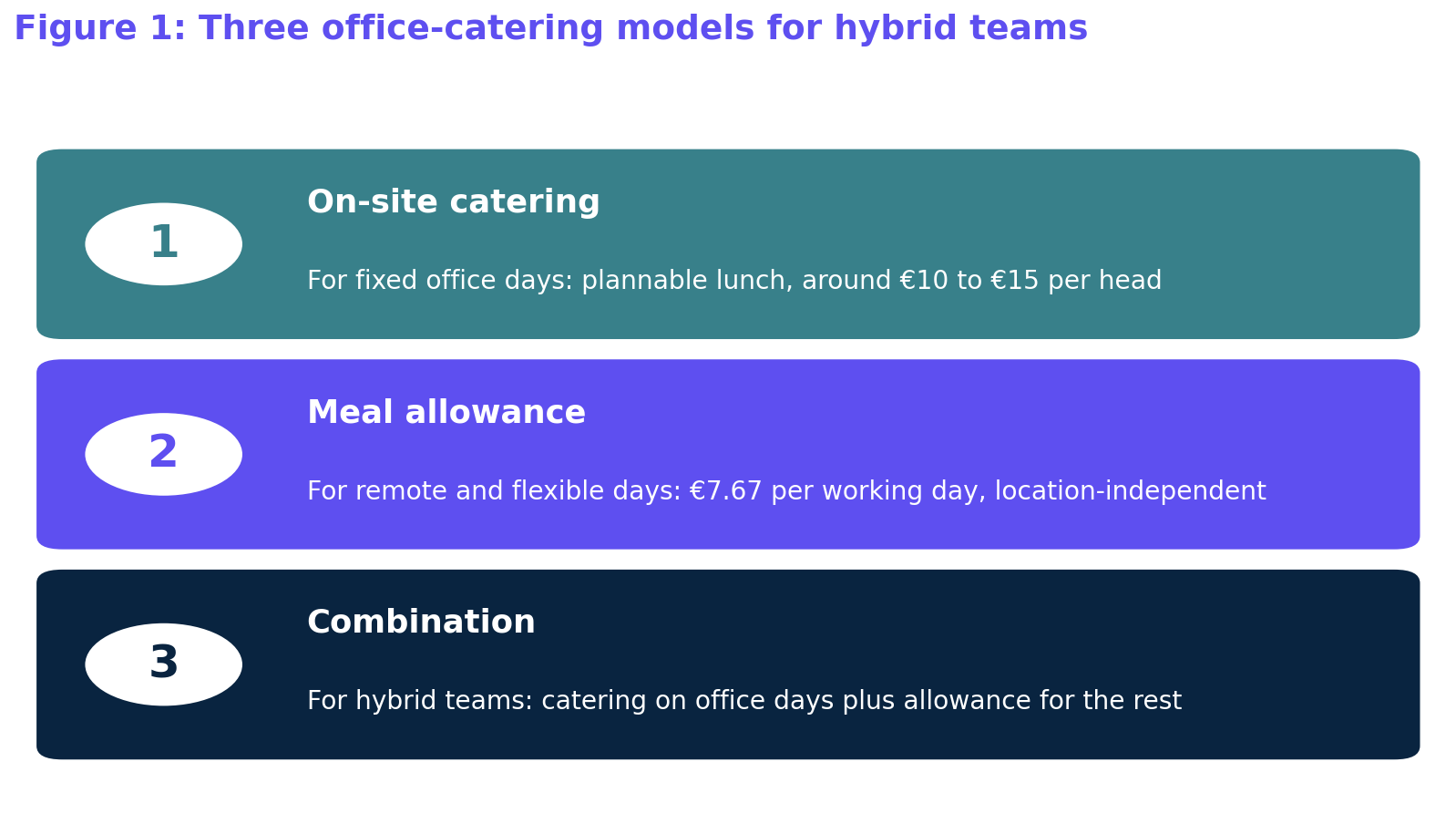
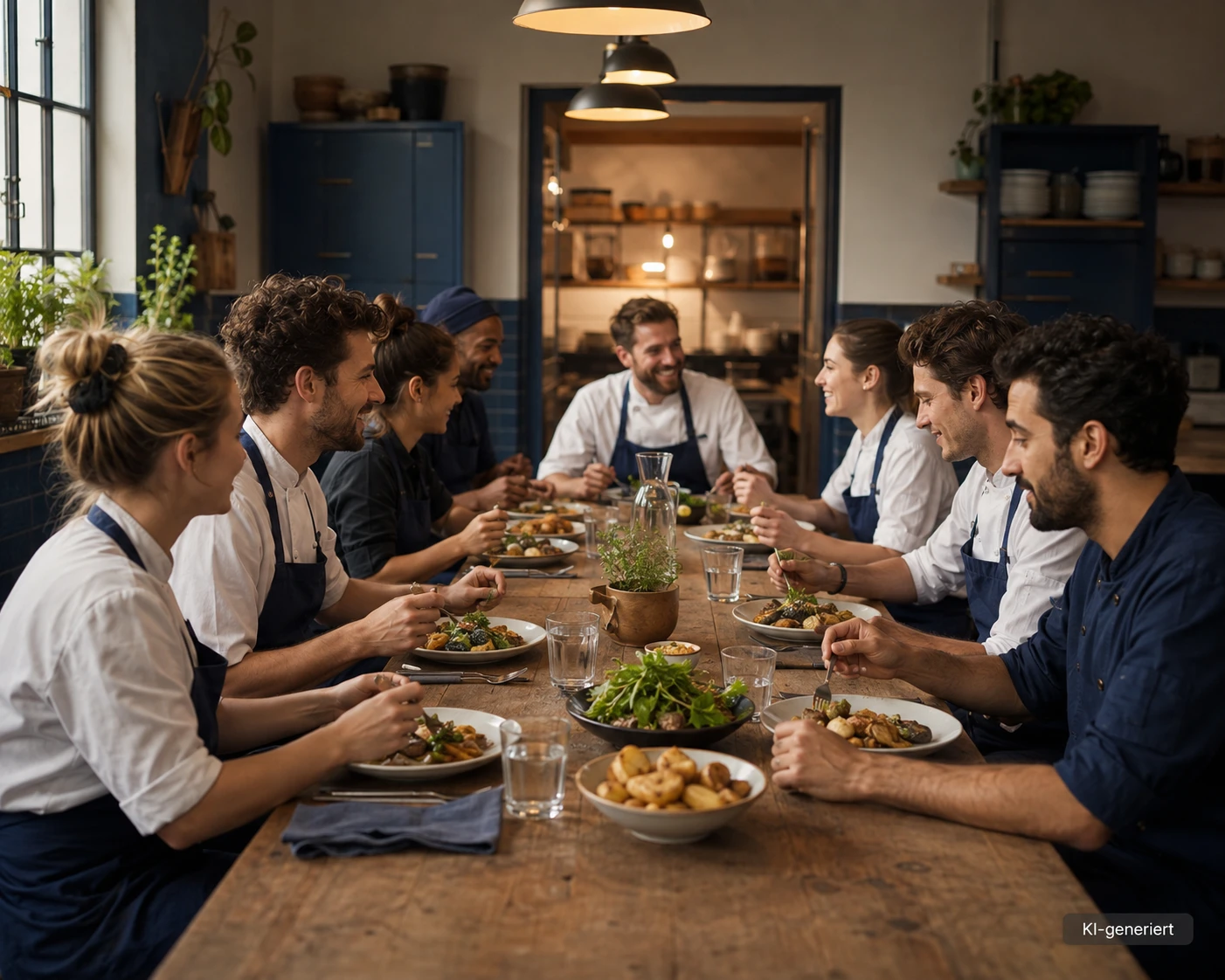
Figure 1: Three models for hybrid teams. On-site catering on fixed office days, around €10 to €15 per head. Meal allowance of €7.67 per working day for remote and flexible days. Combination of both for hybrid teams.
The cost of a plannable office lunch ranges, depending on format and region, from around €10 to €15 per head, well below the €30 to €50 of a classic event buffet. For how these per-head prices break down, see our guide to catering costs for companies. The weakness of the model: on remote days the team gets nothing, and people who rarely come in barely benefit.
3. Model 2: Meal allowance for remote and flexible days
The second model flips the logic. Instead of being tied to a place, the catering follows the employee, whether in the office, at home, or on the road.
The meal allowance does exactly that. In 2026, up to €7.67 per working day is tax-advantaged, consisting of the benefit-in-kind value of €4.57 and an employer top-up of €3.10. Via digital receipt capture, employees redeem it regardless of location, including from home.
For hybrid teams this is ideal, because it makes no assumption about the work location. Everyone gets the same daily rate, no matter where they eat. For how to claim the full rate, see our piece on how to make the most of the meal allowance. The weakness: the shared meal on office days is missing, and the social effect of a common lunch table doesn't arise this way.
Plan office catering for your hybrid team
- Model matched to your attendance ratio
- Catering on office days, allowance for the rest
- Realistic cost per employee
- Matching caterers for your locations

4. Model 3: the combination, and why it fits most teams
The third model unites the strengths of the first two. On office days a caterer delivers; on remote and flexible days the allowance kicks in. That way every working situation gets exactly the right offer.
Economically, it's the cleanest route. You pay for catering only on the days the team is actually there, and use the flexible allowance for the rest, which only applies on actual usage. Idle cost for unused food disappears almost entirely.
The combination also wins on effect. Office days strengthen the team through the shared lunch, while the allowance on remote days signals that appreciation doesn't end at the office door. For most hybrid teams this mix is therefore the obvious choice. The right office catering can be scheduled flexibly around the office days.
The admin effort stays manageable. Catering runs through fixed orders on a few days; the allowance runs through digital receipt capture with automatic handover to payroll. For HR that means two clearly separated, lean processes instead of one complicated catch-all model that tries to treat every day the same.
5. What office catering for hybrid teams costs
The decisive question for HR and Finance isn't the model, but the number per employee per month. And that depends directly on the attendance ratio.
A simplified example makes it tangible. Assume the combination model reckons with around €12 per office day for catering and €7.67 per remote day via the allowance, over 20 working days a month. Then a team with two office days a week lands at around €188 per employee, with three office days at around €205, and at full attendance at around €240.
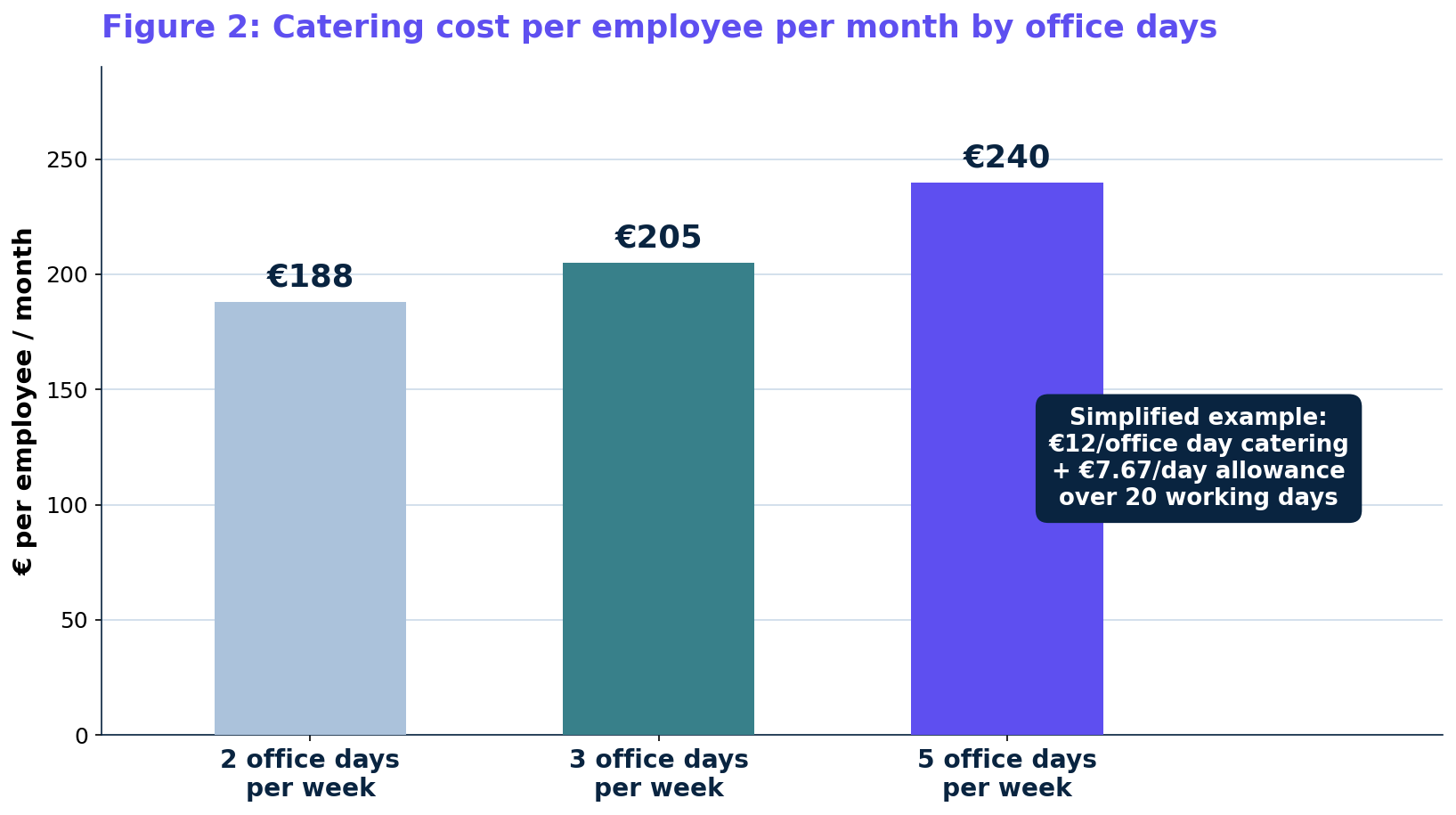
Figure 2: Catering cost per employee per month in the combination model, simplified example with €12 per office day for catering plus €7.67 per day allowance over 20 working days. 2 office days a week: around €188. 3 office days: around €205. 5 office days: around €240.
Important: these are gross planning figures per head, not the net tax cost. With the allowance, part is carried by the employee's own contribution, and the tax advantage lowers the effective burden further. For a detailed budget logic by team size, see our piece on catering cost per employee. The direction is clear: the higher the attendance, the higher the catering share and thus the cost, but also the communal benefit.
6. Providers and logistics: what matters for hybrid teams
A good model often fails in practice on logistics. For hybrid teams, three provider qualities are decisive.
First, flexibility on quantities. Attendance fluctuates, so the order has to adjust at short notice without penalty fees for every change. A provider that only accepts fixed weekly quantities fits hybrid teams poorly.
Second, reliable delivery times. Lunch has to be there on time and in the right quantity, otherwise the office-day anchor fizzles. Third, simple order handling, ideally via a marketplace where several caterers and formats can be compared.
Demand planning itself can be eased by establishing fixed office days. Communicating Tuesday and Thursday as set attendance days yields more reliable numbers than fully free choice. A short weekly sign-up for lunch is usually enough to hit the quantities cleanly.
Variety counts too. A hybrid team doesn't enjoy the same thing every office day, and different diets need covering. A provider that delivers rotating menus plus vegetarian and vegan options keeps acceptance high and stops half the team from sorting their own lunch on office days anyway. Via a marketplace, caterers can also be compared by location, format, and price, which noticeably reduces the effort across multiple offices.
7. Common mistakes when feeding hybrid teams
Three mistakes cost money or acceptance in practice, and all three are avoidable.
First: ordering catering on every day. Having food delivered on remote days too means paying for empty chairs. It costs real money, and it's exactly the line item the catering-plus-allowance combination removes.
Second: not claiming the full meal allowance. Applying only the benefit-in-kind value of €4.57 instead of the full €7.67 gives away around 40% of the tax lever. With a high remote share in particular, that adds up.
Third: not measuring attendance. Without data on who's actually in, every quantity plan is guesswork. A simple sign-up or a rough review of office days is enough to make the order accurate and to avoid both over- and under-supply.
A no-obligation needs analysis for hybrid teams
- Cost per employee calculated for your team
- Optimal mix of catering and allowance
- Accounts for attendance ratio and locations
- Result within a few hours
Conclusion
Office catering for hybrid teams works best when the catering follows fluctuating attendance instead of a rigid plan. On-site catering on fixed office days carries the shared lunch table, the location-independent meal allowance covers the remaining days, and together they put an offer on the table for every working situation.
For a team with two to three office days, this mix lands at €188 to €205 per employee per month in the example, clearly below daily catering for everyone. In practice that means three moves: set fixed office days, raise the allowance to the full €7.67, and start with a provider that adjusts quantities at short notice. Those steps keep the cost per head predictable, with nobody paying for empty chairs on remote days.
FAQ
Which catering model fits hybrid teams?
For most hybrid teams, the combination of on-site catering on fixed office days and the meal allowance for remote days. That way every working situation gets an offer without paying for empty chairs.
What does office catering for hybrid teams cost per employee?
In the simplified combination example with €12 per office day and €7.67 allowance over 20 working days, the cost ranges from around €188 per employee with two office days to around €240 at full attendance.
Why not just order catering every day?
Because on remote days nobody calls up the food and the cost still applies. Catering only on office days plus the allowance for the rest avoids this idle cost.
Does the meal allowance work from home too?
Yes. Via digital receipt capture, employees redeem the allowance regardless of location, including at home. Up to €7.67 per working day is eligible; there's no reimbursement on vacation or sick days.
How do I plan quantities with fluctuating attendance?
With fixed office days and a short weekly sign-up. That makes the numbers more reliable, and the caterer can deliver accurately, without over- or under-supply.
What should I look for when choosing a provider?
Flexible quantities without penalty fees, reliable delivery times, and simple order handling. A marketplace with several caterers and formats makes comparison and short-notice adjustment easier.