

Staff Meals in Hospitality: Obligation, Rules and Misconceptions 2026

1. Staff meals: what they are
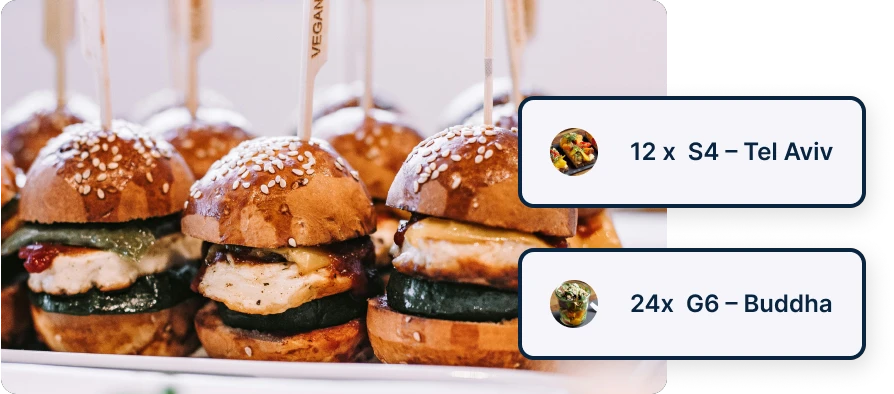
Staff meals refer to the catering a business provides to its employees during working hours. In hospitality this is a tradition: kitchens cook for their own team alongside the guests, often from the same ingredients. The term reaches beyond hospitality, though, and means any form of employer-provided meal, from the canteen to a lunch laid on in the office.
For employers, staff meals are more a retention tool than a cost item. A shared meal structures the day, lowers turnover and makes the business more attractive as an employer. How catering is used strategically is set out in our guide to employee catering in the company.
Two questions come up again and again around the topic. Must an employer offer staff meals at all? And if they do, is the meal then tax-free? Both answers turn out differently from what many assume.
2. Is there an obligation to provide staff meals?
There is no general legal obligation to provide staff meals. The Working Hours Act requires breaks, but not a meal. An employer may offer staff meals but does not have to, and is free to shape them as they wish.
An entitlement only arises through the contract. In hospitality and hotels, some collective agreements contain provisions on staff catering or a payment in lieu. An employment contract or a works agreement can equally promise staff meals. Where such a promise exists, it becomes binding, and the business must deliver or pay the agreed compensation.
A long-standing habit can also turn into what is known as an established company practice, which creates an entitlement. Businesses should therefore decide deliberately whether staff meals are voluntary and revocable or firmly promised. That clarity protects against disputes and against unwanted obligations.
3. Benchmark values 2026: what staff meals are worth for tax
Where the employer provides meals, these are a benefit in kind and must be valued at the official benchmark value. The legislator sets these values annually.
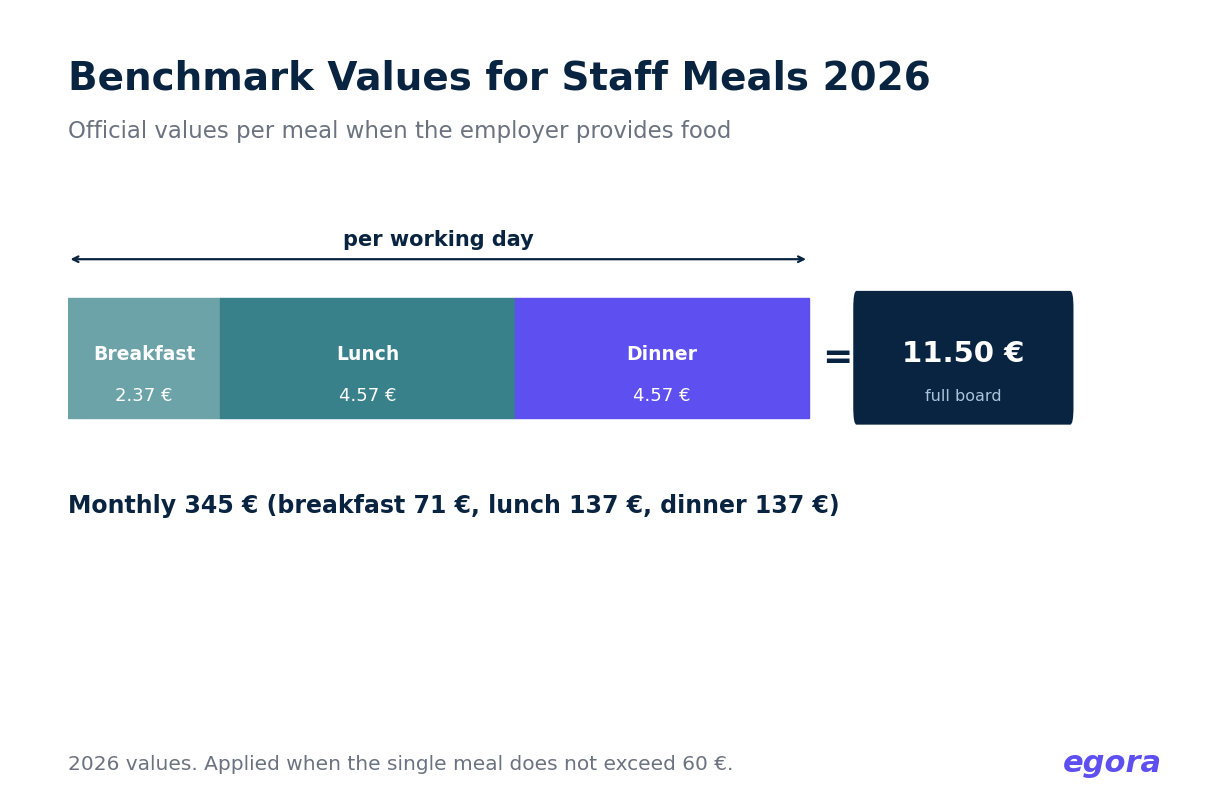
Figure 1: Benchmark values for staff meals 2026, when the employer provides food. Breakfast 2.37 €, lunch 4.57 €, dinner 4.57 €, adding up to 11.50 € per working day for full board. Monthly that is 345 € (breakfast 71 €, lunch 137 €, dinner 137 €). Applied as long as the single meal does not exceed 60 €.
For 2026 the values are 4.57 € per lunch or dinner and 2.37 € for breakfast. For full board that makes 11.50 € per working day and 345 € per month. These values are the basis for payroll, not the actual retail value of the meal. The condition is that the single meal does not exceed 60 €, which normal staff meals always meet.
Whether payroll tax arises depends on the own share. If the employee pays at least the benchmark value for the meal, no taxable benefit arises. If the business provides the meal free or at a discount, the difference is taxable, either through the individual's payroll or at a flat 25 percent. How this framework can be used deliberately for a tax-free allowance is shown in our guide to the meal allowance.
Set up staff catering without tax traps
- The right form of catering for your business
- Per-head price transparently stated
- Combinable with a meal allowance
- Quote within a few hours

4. The most common misconceptions
A few assumptions persist around staff meals that do not hold up in practice. A sober look separates myth from rule.
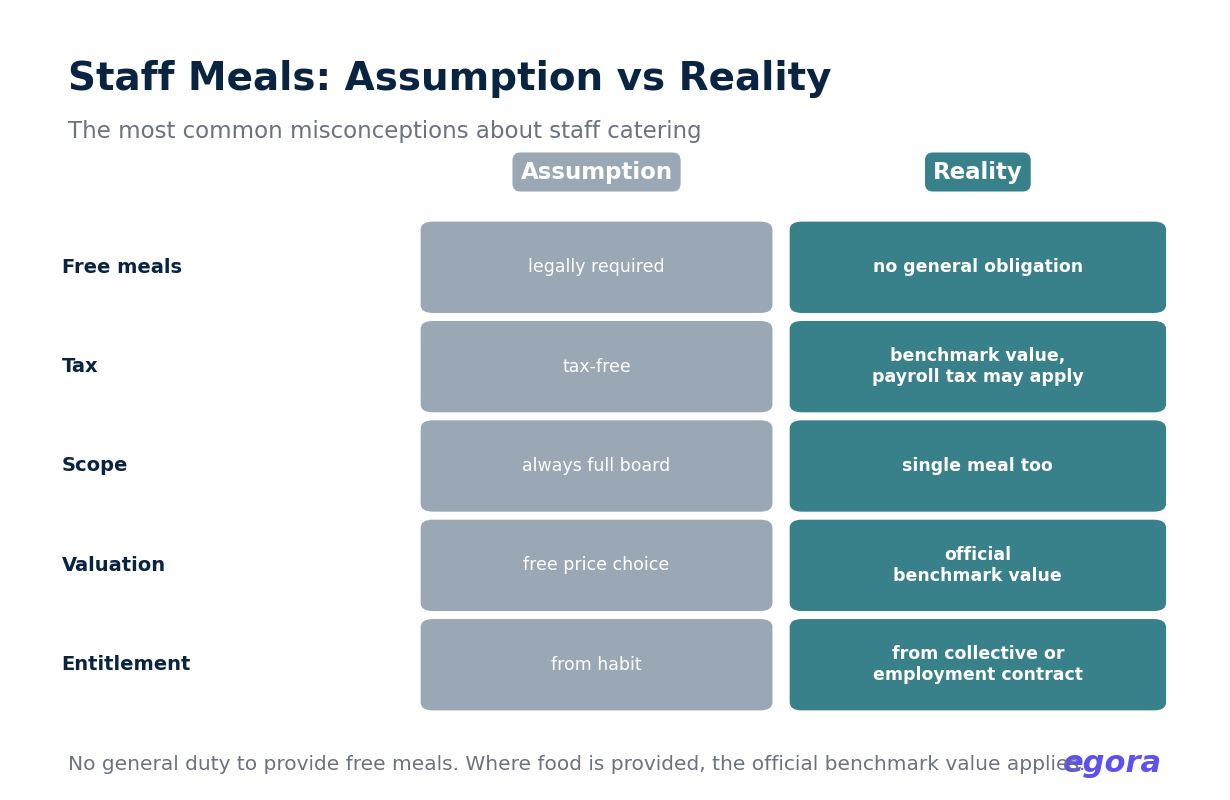
Figure 2: Staff meals, assumption versus reality. Free meals: no general obligation. Tax: not a tax-free given, the benchmark value applies and payroll tax may follow. Scope: not necessarily full board, a single meal is possible too. Valuation: not the free price, the official benchmark value counts. Entitlement: not from habit alone, it follows from a collective or employment contract.
The first misconception is the obligation: many believe a business must provide free food, yet a general rule to that effect is missing. The second concerns tax: staff meals are not a tax-free given; the benchmark value applies, and without a sufficient own share payroll tax follows. The third is the scope: it need not be full board, a single meal can be settled cleanly too. The fourth is the valuation: not the market price of the meal counts, the official value is decisive. And the fifth is the entitlement, which follows from a collective or employment contract, not from mere habit.
5. Accounting for staff meals correctly
The rules lead to a manageable practice. The business decides whether to provide food free, at a discount or against the full own share, and derives the accounting from that. With an own share equal to the benchmark value, the meal stays free of payroll tax, which keeps the accounting simplest.
Two conditions apply. The benchmark values are for meals from a canteen, restaurant or comparable facility run by the employer, and the single meal may not exceed 60 €. For employees in the home office the benefit in kind does not apply; there a receipt-based meal allowance fits better. The exact treatment in an individual case is settled by payroll or a tax advisor, especially where a collective agreement is involved.
A hospitality example makes the accounting tangible. If the kitchen cooks the team's lunch alongside the guests and gives it out free, 4.57 € per person and day counts as a benefit in kind, so around 100 € a month over 22 working days. The business taxes this amount at a flat 25 percent or through the individual's payroll. If the business instead has employees pay the benchmark value of 4.57 € per meal, the tax falls away and only the documentation per person and day remains.
Clean records show, per person and day, which meal was provided and what own share was paid. This record is the basis for payroll and for a possible audit. A business that caters regularly sets the process up cleanly once and saves ongoing effort afterwards.
6. Alternatives and combination
Staff meals from an in-house kitchen pay off mainly where cooking happens anyway, that is in hospitality and in businesses with a canteen. For everyone else the in-house kitchen is rarely economical, and attention turns to the alternatives.
The cost comparison is clear. An in-house kitchen ties up staff, equipment and floor space and only pays off from a high and constant number of meals. Delivered catering and the allowance, by contrast, cause only variable costs per head and day, without fixed overhead for operation and maintenance. For most offices and smaller businesses the delivered or subsidised option is therefore the cheaper and more flexible solution, because it flexes with actual attendance.
Two alternatives present themselves. The first is delivered office catering, which enables a shared lunch without an in-house kitchen and can be calculated per head. The second is the meal allowance, which does not provide the meal itself but subsidises the cost and stays tax-free up to 7.67 € per working day. It suits distributed and hybrid teams in particular, because it also works in the home office.
Often the routes complement each other. A business with a canteen covers office days with staff meals and gives the allowance for home or field-service days. How to plan catering costs per head is set out in our article on healthy employee catering, and the wider frame comes from the overview of corporate catering.
Work out the catering budget per employee
- Budget per employee and month at a glance
- Staff meals, catering and allowance compared
- Tax-free shares cleanly itemised
- Advice with no obligation
Conclusion
Staff meals are not an obligation but a decision: no law compels a business, only a collective or employment contract turns them into an entitlement. Where the employer provides meals, they count at the benchmark value of 4.57 € per main meal and 11.50 € for full board, and an own share at that level keeps things tax-free.
For businesses without their own kitchen, the more practical route runs via delivered office catering or the meal allowance of up to 7.67 € per day. Knowing the rules and setting the own share correctly lets a business feed its team reliably, without falling into the common tax and obligation traps.
FAQ
Are employers obliged to provide staff meals?
No, there is no general legal obligation. The Working Hours Act requires breaks, but not a meal. An entitlement only arises from a collective agreement, an employment contract or a works agreement, or from a long-standing established company practice.
How are staff meals valued for tax in 2026?
At the official benchmark value: 4.57 € per lunch or dinner, 2.37 € for breakfast, adding up to 11.50 € per day for full board and 345 € per month. These values apply as long as the single meal does not exceed 60 €.
Are free staff meals tax-free?
Not automatically. If the business provides the meal free or at a discount, the benchmark value is taxable, through payroll or at a flat 25 percent. If the employee pays an own share equal to the benchmark value, the meal stays tax-free.
Does the benchmark value apply in the home office too?
No. The benchmark value applies to meals from a canteen, restaurant or comparable facility run by the employer. For the home office a receipt-based meal allowance fits instead, which stays tax-free up to 7.67 € per working day.
What is the difference between staff meals and a meal allowance?
With staff meals the business provides the meal itself and values it at the benchmark value. With the meal allowance it provides no meal but contributes to the cost on favourable tax terms, up to 7.67 € per day. The allowance also works away from the business and in the home office.
Is an in-house kitchen worth it for staff meals?
Mainly where cooking happens anyway, that is in hospitality and in businesses with a canteen. For others the in-house kitchen is rarely economical. Delivered office catering or a meal allowance cover the catering without a fixed kitchen operation and can be calculated per head.
Similar articles



Get an individual menu suggestion today.