

Office Breakfast: Models, Providers and Costs 2026

1. Why an office breakfast pays off
A shared breakfast brings the team together before the day breaks up into meetings and projects. It lowers the barrier to a quick exchange between departments and creates a relaxed start that feeds into the mood in the office. For many teams, breakfast is the lowest-threshold occasion to come together at all.
For companies the effort is low and the effect high. A breakfast costs far less per head than a lunch and still works as a visible sign of appreciation. How catering is used strategically is set out in our guide to employee catering in the company.
For hybrid teams in particular, breakfast is a good anchor. A fixed breakfast day draws people into the office where the journey is worth it, because you meet colleagues. That turns catering into a reason for attendance without needing an obligation.
2. The models at a glance
An office breakfast can be run in five models, differing in effort, variety and price. The classification helps to find the right one quickly.
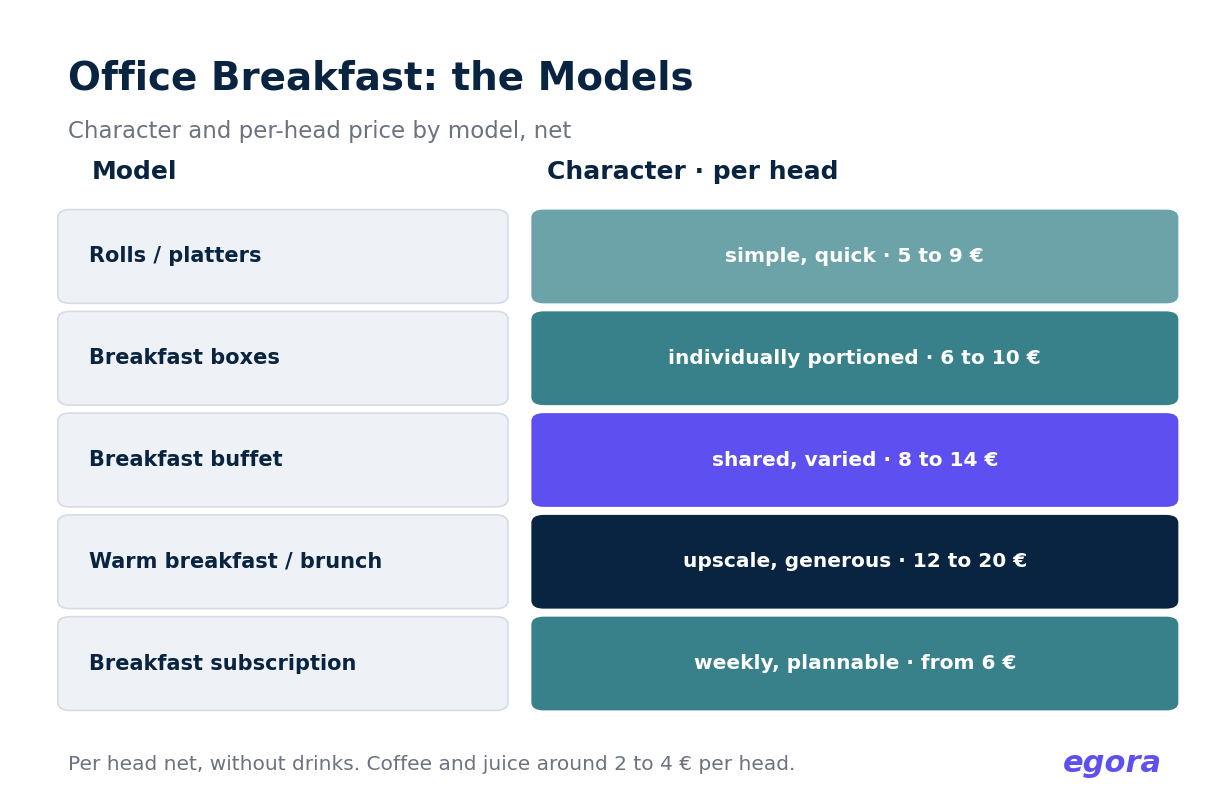
Figure 1: Office breakfast by model, per-head price net without drinks. Filled rolls or platters simple and quick, around 5 to 9 €. Breakfast boxes individually portioned, around 6 to 10 €. Breakfast buffet shared and varied, around 8 to 14 €. Warm breakfast or brunch upscale and generous, around 12 to 20 €. Breakfast subscription weekly and plannable, from around 6 €. Coffee and juice around 2 to 4 € per head.
Filled rolls and platters are the simplest variant: quickly delivered, no setup, ideal for a short breakfast on the side. Breakfast boxes give everyone their own portion, which suits distributed seating and hygiene requirements. The breakfast buffet brings variety and the shared moment at the table, from bread and cold cuts through muesli and fruit to pastries. A warm breakfast or a brunch with scrambled eggs, warm dishes and more choice turns breakfast into a small occasion. The breakfast subscription, finally, sets a fixed rhythm, for example every Friday, and lowers the organisational effort. How a more generous format can be arranged is explored in our article on brunch in the office.
Which model fits depends on team size and occasion. Small teams up to around fifteen people do best with platters or boxes, because they need no setup and are easy to distribute. Medium to large teams benefit from the buffet, which creates variety and the shared moment at the table. For a special occasion or a longer get-together, the warm breakfast is worth it, offering more time and choice.
3. Recognising and choosing providers
A good breakfast provider delivers on time, fresh and in the right quantity. Three questions separate the right caterer from the wrong one. How early and how reliably is delivery, so the breakfast is ready before work starts? How fresh are the bread, fruit and cold cuts, and where do they come from? And how flexibly can the order be adjusted to actual attendance?
Variety comes on top. An offer with vegetarian and vegan options plus lactose- and gluten-free alternatives makes sure everyone can join the breakfast. For regular office days, structured office catering is worth a look, as it organises delivery and choice and keeps ordering lean.
Quantity planning is the third point. A provider that asks the headcount precisely and plans for leftovers saves food waste and cost. For a breakfast that handles the fluctuating attendance of hybrid teams, this flexibility counts more than the largest possible offer.
Request an office breakfast
- Model matched to team size
- Fresh delivery before work starts
- Vegetarian, vegan and free-from options
- Per-head price transparently stated

4. What an office breakfast costs
The per-head price depends on the model and the ambition. The ranges overlap, because choice and freshness vary within each model.
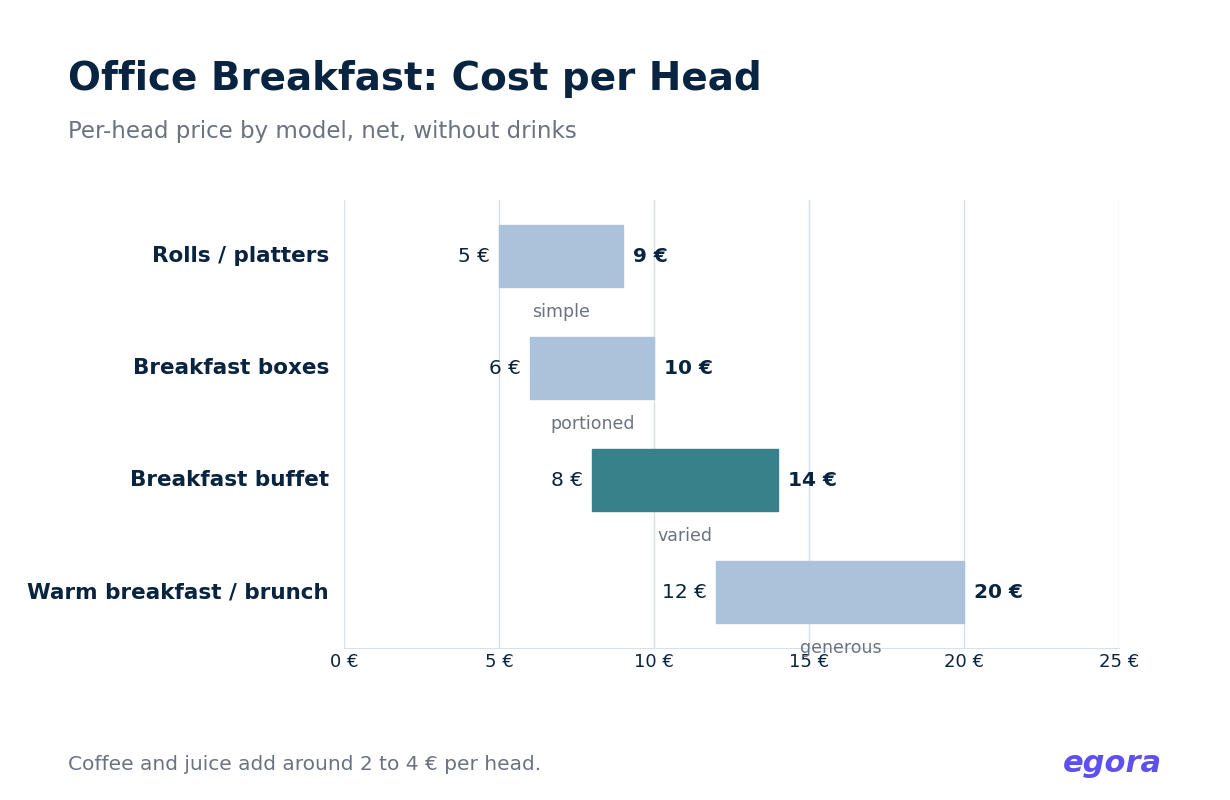
Figure 2: Office breakfast, per-head price by model, net and without drinks. Filled rolls or platters around 5 to 9 €, breakfast boxes around 6 to 10 €, breakfast buffet around 8 to 14 €, warm breakfast or brunch around 12 to 20 €. Coffee and juice add around 2 to 4 € per head.
Filled rolls and platters, at around 5 to 9 € per head, are the cheapest model, followed by breakfast boxes at around 6 to 10 €. The breakfast buffet sits at around 8 to 14 €, the warm breakfast or brunch at around 12 to 20 €. Coffee and juice add around 2 to 4 € per head across all models. A worked example: a breakfast buffet for 25 people at 11 € per head costs around 275 € per session, plus drinks around 75 €, so around 350 €. At a weekly rhythm that adds up to around 1,400 € a month. How frequency affects value and cost is set out in our article on how much catering per week makes sense.
5. Frequency, occasions and tax
How often an office breakfast happens depends on the goal and the budget. A weekly breakfast day creates a reliable fixed point, while a monthly breakfast stays visible and cheaper. Alongside that, occasion-based breakfasts fit well, for example for onboarding, the start of a quarter or as a thank-you after an intense project.
A few building blocks give breakfast variety. A bowl or porridge day with toppings to assemble, a hearty breakfast with warm scrambled eggs and roast potatoes, or a regional breakfast with cheese, cold cuts and fresh bread alternate well. Seasonal accents like fresh berries in summer or cinnamon pastries in winter keep the breakfast day interesting without changing the per-head price.
On the tax treatment a brief look pays off, though it does not replace advice for the individual case. An occasional breakfast for a special occasion is often treated as a small courtesy and stays favoured up to a threshold. A regular, daily breakfast, by contrast, may count as a benefit in kind. The exact classification is settled by payroll or a tax advisor once a fixed rhythm is planned.
Beyond tax, the healthy choice counts. A breakfast with fruit, wholegrain and a light warm option goes down better than a plain pastry platter and fits a conscious approach to catering. How healthy employee catering works in practice is explored in our article on healthy employee catering.
6. Organisation and enquiry
With model, rhythm and budget the framework stands; what is missing is clean organisation. Four details make any enquiry reliable: team size, desired rhythm, model and dietary needs such as vegetarian, vegan or gluten-free.
Two points keep breakfast running smoothly. The delivery time should be clearly before work starts, so everything is ready when the team arrives. And attendance should be roughly estimated per session, so the quantity fits and no leftovers arise. Once a recurring frame is in place, the office breakfast runs with little effort and reliably delivers its value.
Have your breakfast budget calculated
- Per-head price and monthly budget at a glance
- Models from box to brunch
- Vegetarian, vegan and free-from options
- Delivery to the office, fixed weekday

Conclusion
An office breakfast becomes plannable once the model fits the team. Small teams do well with platters or boxes at around 5 to 10 € per head, larger ones with a buffet at around 8 to 14 €, and anyone who likes it generous chooses a warm breakfast or a brunch at around 12 to 20 €. Coffee and juice add around 2 to 4 € per head.
For the choice, freshness, delivery time and a flexible quantity count more than the largest offer. A fixed breakfast day draws hybrid teams into the office, and a few vegetarian and vegan options make sure everyone can join in. Setting the rhythm once gives a reliable fixed point with little effort.
FAQ
What does an office breakfast cost per person?
Depending on the model, around 5 to 9 € for filled rolls or platters, 6 to 10 € for breakfast boxes, 8 to 14 € for a breakfast buffet and 12 to 20 € for a warm breakfast or brunch, net in each case. Coffee and juice add around 2 to 4 € per head.
Which models are there for an office breakfast?
Filled rolls and platters, individually portioned breakfast boxes, a breakfast buffet, a warm breakfast or brunch, and a breakfast subscription with a fixed rhythm. For small teams, boxes or platters fit; for larger ones, a buffet.
How often should an office breakfast take place?
A weekly breakfast day creates the most reliable fixed point, while a monthly breakfast stays visible and cheaper. Occasion-based breakfasts fit alongside, for example for onboarding or the start of a quarter. A breakfast buffet for 25 people sits at around 350 € per session.
Is an office breakfast tax-free?
An occasional breakfast for a special occasion is often treated as a small courtesy and stays favoured up to a threshold. A regular, daily breakfast may count as a benefit in kind. The exact classification is settled by payroll or a tax advisor for the individual case.
What should you watch when choosing a provider?
On-time delivery before work starts, fresh ingredients and a flexible adjustment of the quantity to actual attendance. Vegetarian, vegan and free-from options belong in. A good provider asks the headcount precisely and plans for leftovers to avoid food waste.
Does a breakfast work for hybrid teams?
Yes, especially with a fixed breakfast day that draws people into the office. Attendance should be roughly set per session, so the quantity fits. That turns breakfast into a reason for attendance without needing an obligation.
Similar articles




Get an individual menu suggestion today.