


Sustainable Corporate Catering: Costs, Criteria and Providers 2026
1. Why sustainability matters in corporate catering
Sustainability in corporate catering has moved from a nice-to-have to an expectation. Staff pay attention to origin and packaging, and in many companies catering feeds into ESG and sustainability targets. Catering that buys regionally and avoids waste becomes a visible part of the company culture.
The framework has also shifted legally. Since 1 January 2023, caterers and canteens must always offer a reusable option alongside single-use packaging, and it may not cost more than the single-use version. Sustainability is therefore no longer only a wish but in parts a requirement. How catering is planned in general is set out in our guide to employee catering in the company.
The most common reservation is about cost. The assumption that sustainable automatically means expensive does not hold up to a careful calculation. Some criteria raise the price, others lower it, and overall the premium stays manageable.
2. The criteria: how to recognise sustainable catering
Sustainability in catering is not a single feature but a bundle of several. Six criteria help to judge an offer instead of relying on a green label.
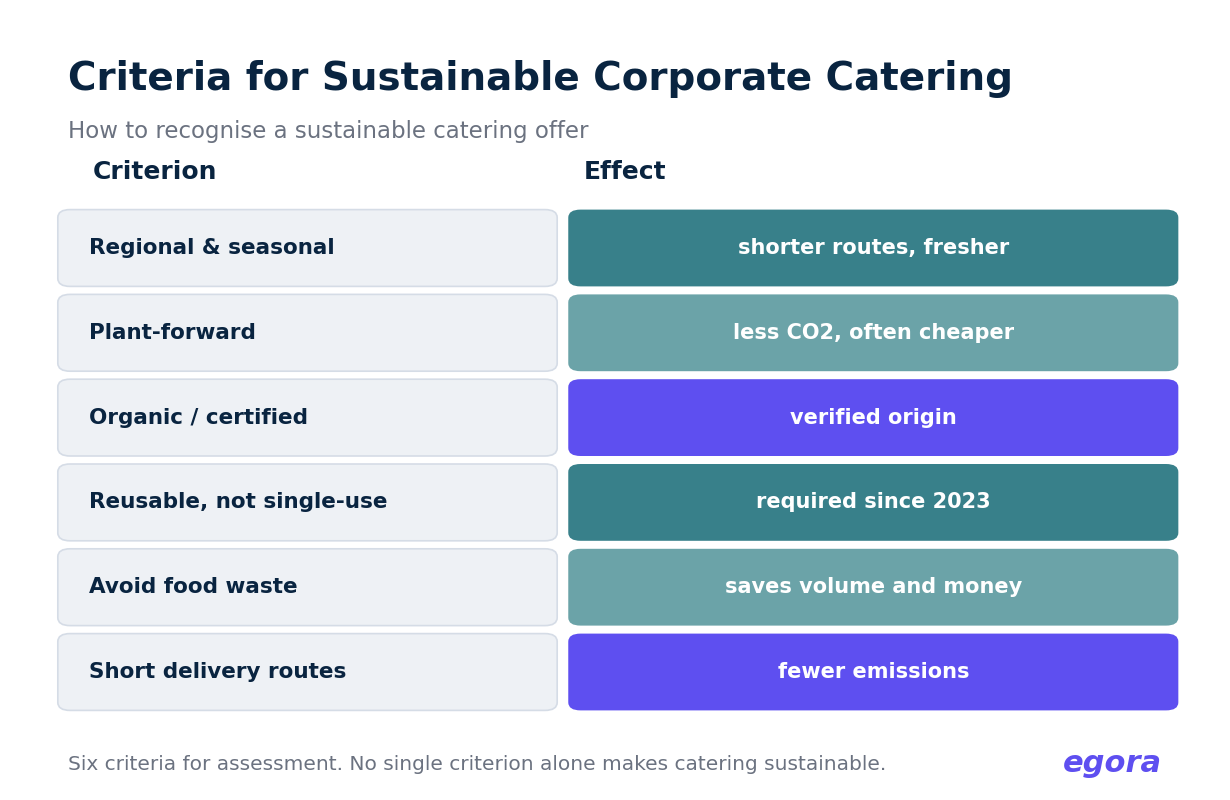
Figure 1: Criteria for sustainable corporate catering and their effect. Regional and seasonal means shorter routes and more freshness. Plant-forward cuts CO2 and often cost. Organic and certified stands for verified origin. Reusable instead of single-use has been required since 2023. Avoiding food waste saves volume and money. Short delivery routes lower emissions. No single criterion alone makes catering sustainable.
The first criterion is origin: regional and seasonal ingredients travel shorter routes and arrive fresher. The second lever is the plant share, because vegetables, pulses and grains cause far less CO2 than meat and are cheaper to buy. Organic and recognised certificates document the origin in a traceable way. Reusable instead of single-use cuts packaging waste and meets the legal requirement at the same time. Avoiding food waste through accurate quantities saves resources and cost. And short delivery routes keep transport emissions low. How healthy and sustainable catering works across a weekly plan is explored in our article on healthy employee catering.
3. The legal framework in 2026
Beyond the voluntary criteria, the law sets a framework that tightens in 2026. The reusable-packaging obligation under the packaging act has applied since 2023 and covers caterers and canteens explicitly. The reusable option must be offered on equal or better terms than single-use.
Two developments come on top in 2026. The EU packaging regulation PPWR sets new rules for packaging and its reuse after a transition period. And from September 2026, terms such as sustainable or recyclable may only be used if they are clearly and verifiably backed up. For choosing a provider that means: anyone advertising sustainability must be able to prove it. Blanket promises without evidence lose their value.
For companies this is a chance for clarity. A caterer that makes origin, reuse and quantity planning transparent meets the new requirements and at the same time delivers the evidence that internal sustainability reports need.
Request sustainable corporate catering
- Regional and seasonal providers
- Plant-forward and organic options
- Reusable instead of single-use, as legally intended
- Per-head price transparently stated
4. What sustainability costs
The cost question decides how seriously sustainability is taken in a business, so a close look pays off. A conventional office lunch costs around 8 to 14 € per head. A sustainable offer with organic and regional sourcing reaches around 9 to 16 €, because verified ingredients carry a premium.
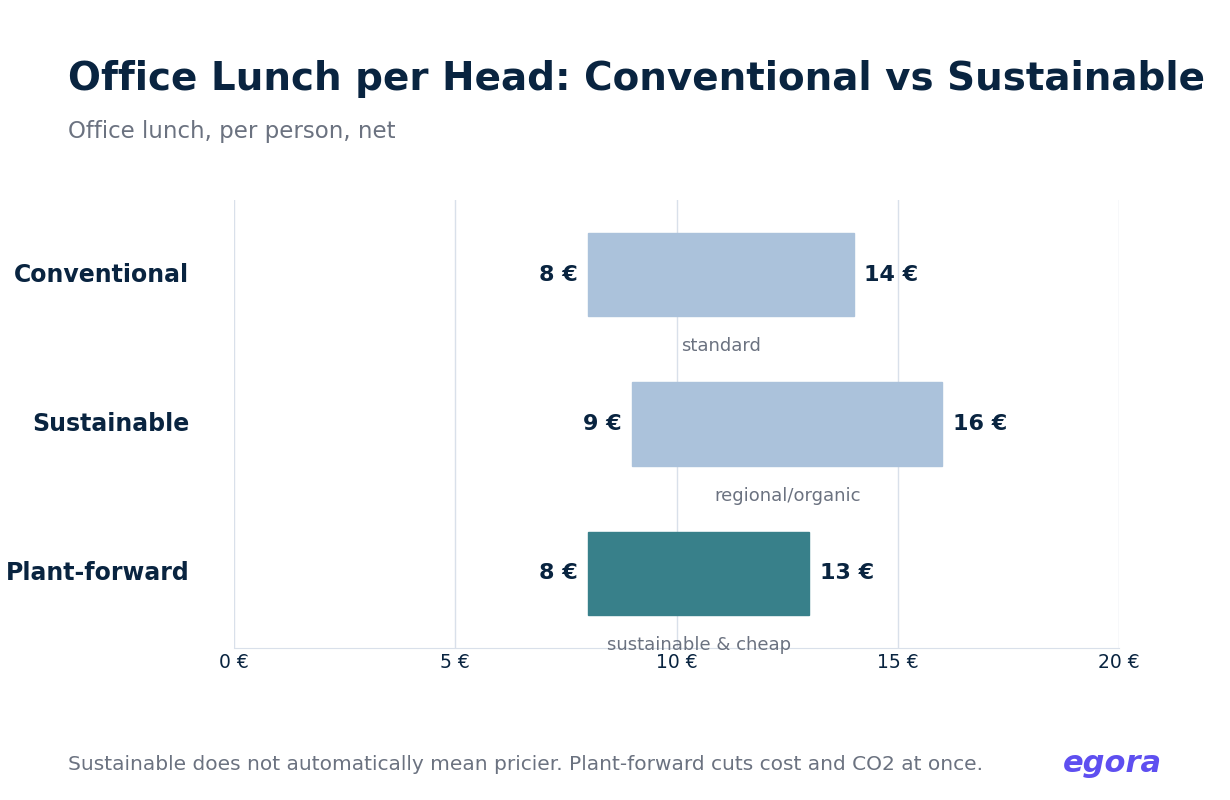
Figure 2: Office lunch per head, net. Conventional around 8 to 14 €. Sustainable with regional and organic around 9 to 16 €. Plant-forward and sustainable around 8 to 13 €, at or below the standard level. Sustainable does not automatically mean pricier; a plant-forward offer cuts cost and CO2 at once.
The plant-forward route turns the calculation around. An offer with a high share of vegetables and pulses costs around 8 to 13 € per head, at or below the conventional level, because meat is the most expensive item to buy. On top comes the saving from accurate quantity planning: avoiding food waste means ordering to fit and not paying for leftovers. Overall the premium sits between cost-neutral and around 15 percent depending on the chosen criteria. How to steer catering costs in general is shown in our overview of catering costs for companies, and the per-head format comparison comes from our price comparison of buffet, set menu and finger food.
A worked example makes the premium tangible. For a team of 40 people on three days per week, a conventional lunch runs at around 1,400 to 2,400 € per month. A sustainable offer with organic and regional sourcing costs around 1,550 to 2,700 €, while a plant-forward one stays in the same range at around 1,400 to 2,250 €. The extra cost for organic and regional therefore comes to a few hundred euros a month, which a higher plant share offsets in full or in part. For budget planning that means sustainability is a question of weighting, not of doing without.
5. Recognising and choosing providers
A credible provider proves its sustainability rather than merely claiming it. Three questions separate genuine commitment from a green front. Where do the main ingredients come from, and is there evidence? How high is the plant share on the menu, and can it be raised flexibly? And how is packaging handled, with real reuse or only a nod to recycling?
Quantity planning comes on top. A good caterer asks the guest count precisely and plans for leftovers instead of adding a blanket margin. That lowers food waste and cost at the same time. For regular office catering, a provider that delivers sustainability as standard rather than selling it as an expensive extra pays off.
Certificates help with orientation but do not replace a look at the practice. An organic seal says something about the ingredients, nothing about packaging or transport. So it is the overall picture of origin, share, reuse and delivery route that counts, not a single label.
6. Rolling it out in the business
With criteria, costs and a provider profile the framework stands; what is missing is the route into everyday practice. Four steps bring sustainable catering reliably into the business.
First the priorities: decide which criteria matter most, for example regional sourcing and reuse ahead of an organic certificate. Then the budget, which factors in the premium of between zero and around 15 percent and finances it through a higher plant share. Next comes the provider choice based on the three questions about origin, share and packaging. Finally the quantity planning that keeps food waste small from the start.
A pragmatic entry lowers the hurdle. Instead of switching everything at once, you start with a higher plant share and reuse, because both levers work quickly and do not push up cost. Organic and regional can be expanded step by step once the format is set and the team supports the change.
Plan cost and sustainability together
- Per-head price and premium transparent
- Plant-forward as a cost offset
- Regional providers with reusable packaging
- Advice with no obligation
Conclusion
Sustainable corporate catering can be pinned to six criteria: region, plant share, organic, reuse, little food waste and short routes. Keeping all of them in view helps to spot genuine offers and avoid empty promises, which from 2026 also become legally challengeable.
On cost, the biggest reservation dissolves. A plant-forward offer sits at the standard level at around 8 to 13 € per head, organic and regional lift the price to around 9 to 16 €, and overall the premium stays between zero and around 15 percent. The fastest entry runs via more plant-based food and reuse, because both work at once and spare the budget.
FAQ
What makes corporate catering sustainable?
A bundle of six criteria: regional and seasonal ingredients, a high plant share, verified organic origin, reusable instead of single-use, avoiding food waste and short delivery routes. No single feature is enough; it is the overall picture of origin, packaging and quantity that counts.
Is sustainable catering more expensive?
Not necessarily. A plant-forward offer costs around 8 to 13 € per head, at or below the conventional level of around 8 to 14 €. Organic and regional sourcing lift the price to around 9 to 16 €. Overall the premium sits between cost-neutral and around 15 percent.
Does the reusable-packaging rule apply to catering?
Yes. Since 1 January 2023, caterers and canteens must always offer a reusable option alongside single-use, and it may not cost more than the single-use version. From 2026 the EU packaging regulation and the rules against misleading environmental claims tighten the requirements further.
How do I recognise a genuinely sustainable provider?
By verifiable answers to three questions: where the main ingredients come from, how high the plant share is and how packaging is handled. A credible caterer also plans quantities precisely to avoid food waste. Certificates help but do not replace a look at the practice.
Which lever saves the most CO2 and cost at once?
The plant share. Vegetables, pulses and grains cause far less CO2 than meat and are cheaper to buy. A higher plant share therefore lowers emissions and cost at the same time and often finances the premium for organic and regional.
What is the best way to start with sustainable catering?
Step by step. First raise the plant share and switch to reusable packaging, because both levers work at once and do not push up cost. Organic and regional sourcing can be expanded afterwards, once the format is set and the team supports the change.
Similar articles

Get an individual menu suggestion today.