

Bringing Your Own Caterer to a Berlin Venue [2026]

1. First Things First: It's a Contract Issue, Not a Legal One
There's no German law forcing event venues to allow or block outside caterers. It comes down to freedom of contract. Whatever your rental contract says is what counts.
A verbal yes from the sales team won't help if the contract has an in-house catering clause. Read the "Catering" or "Bewirtung" section twice before you sign.
Berlin has one of the densest event scenes in Europe, with over 1,200 bookable spaces. Competition between venues is fierce, so many will negotiate on outside catering even when their boilerplate says otherwise. If you're still hunting for a venue, check our Berlin venue guide.
You'll come across three contract models in Berlin venues.
In-house only. The venue picks the caterer. You pay what they ask. No comparison shopping. Standard at 5-star hotels and restaurants with private event rooms.
Fee-based (Korkengeld). Outside caterers are allowed, but you pay the venue between €8 and €25 per guest. Officially, the fee covers cleaning, waste, and access to dishes. Realistically, it's also a buffer for the venue against losing in-house catering revenue. Common at industrial lofts and museums.
Free choice. No fee, no restrictions. The most valuable model if you control the budget. You can shop the real market. Open-air spaces and some converted factories work this way.

2. Outside Catering Fees in Berlin: What's Realistic
Korkengeld is negotiable. Anyone who knows the market rarely pays the first number quoted.
Ranges vary widely by venue type. Industrial lofts in Mitte and Friedrichshain typically run €8 to €15 per guest. Museums and cultural venues ask €15 to €25. Hotel event spaces sit at the high end, €18 to €30. Converted factories in Kreuzberg and Wedding are the most flexible at €5 to €12.
Worked example, 80 guests at an industrial loft:80 guests times €12 in fees adds up to €960 in extra cost. If the in-house caterer charges €65 per head and an outside caterer comes in at €42, you still save around €880 net even after the fee. Below 30 guests, the math often flips toward in-house, since the per-head fee weighs more on small groups.
To capture every cost, take a look at hidden catering costs. Minimum order values also matter when booking outside caterers, which is covered in the minimum order guide.
Find vetted caterers for your Berlin venue

3. Contract Clauses, Food Safety, and Liability
Not everything in a contract is enforceable, but most of it is. In-house catering clauses hold up if they're transparent. Flat-rate Korkengeld is standard. So is required food safety documentation, proof of insurance, set delivery windows, and waste handling fees.
Borderline or negotiable: fees over €30 per guest with no clear justification, blocking outside drinks while allowing outside food, or making you use the venue's serving staff at inflated hourly rates.
Rule of thumb: anything that smells like a hidden commission is up for negotiation. Venues fold in 60% to 70% of cases when you put a competing quote on the table.
Food safety and liability are non-negotiable but standard. Venues can ask the outside caterer for a business registration (Gewerbeanmeldung), §43 Infection Protection Act (IfSG) certification, HACCP documentation, liability insurance with at least €1 million in coverage, and registration with the local food safety authority (Veterinär- und Lebensmittelaufsichtsamt).
Vetted caterers on a B2B catering marketplace bring these papers automatically. If you book a small operator directly, ask to see them before you sign anything. Missing insurance can shift liability to you if something goes wrong.
4. In-House vs. Outside Caterer: The Numbers
In-house catering isn't always more expensive, but for standard events, it almost always is. The gap shows up in three places: food pricing, drink margins, and service fees.
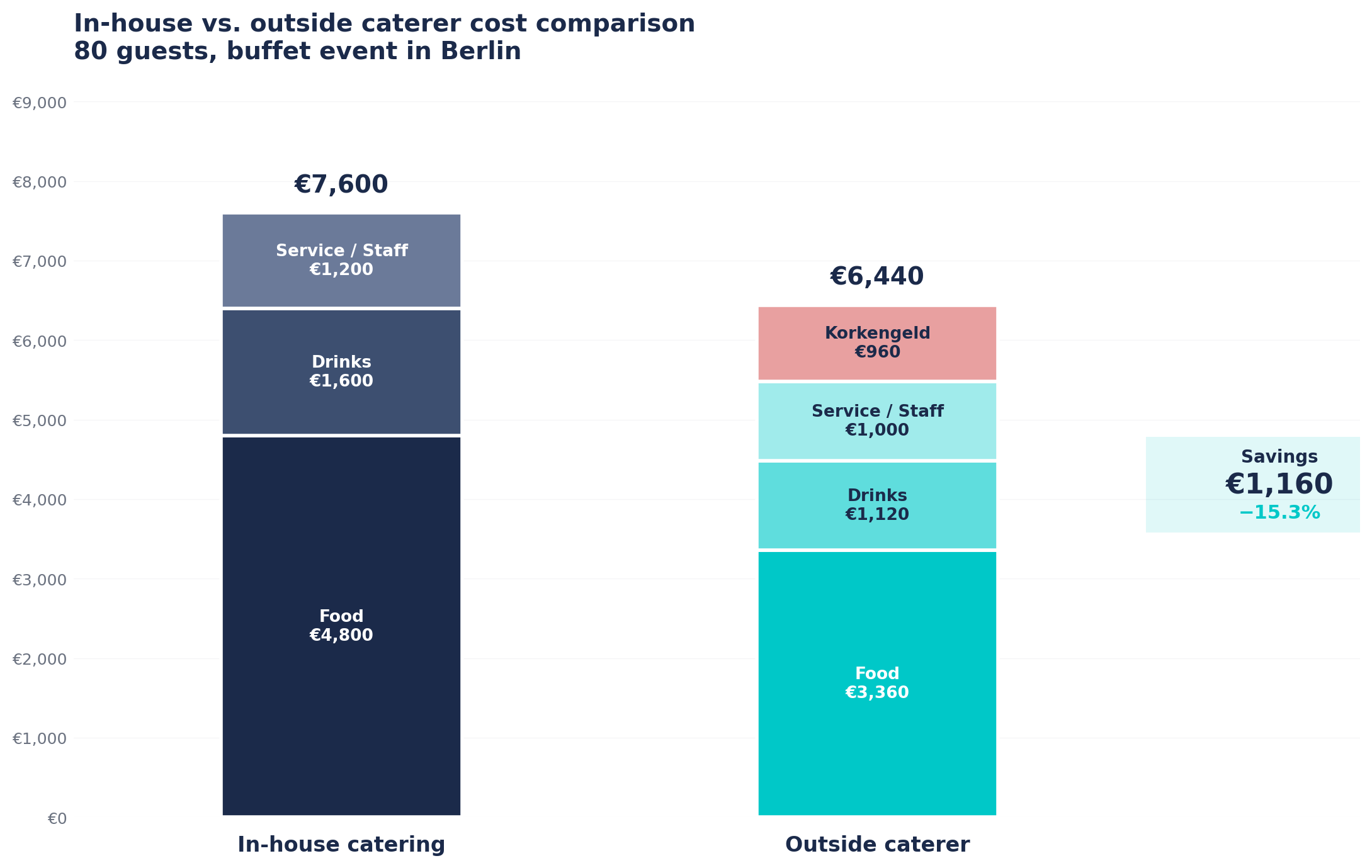
Take a buffet event for 80 guests in Berlin. The in-house option typically runs around €7,600 total. An outside caterer of comparable quality lands at €5,480 for food, drinks, and service, plus €960 in fees, for €6,440 total. That's a €1,160 difference, or 15.3%. The savings scale up as events get larger.
For a fuller breakdown, see catering costs for businesses. If you need a per-employee view, use budget planning for 30 to 200 employees.
5. Berlin Venue Types and Their Catering Policies
Catering policy varies a lot by venue type.
Five-star hotels like the Adlon, Westin, or Marriott-class properties enforce strict in-house policies and rarely budge. Museums like the Gemäldegalerie or Bode-Museum work with preferred-caterer lists, sometimes expandable. Industrial lofts like Spreespeicher or Kraftwerk usually handle outside catering flexibly, either fee-based or free choice. Restaurants with event rooms insist on in-house. Conference centers run on in-house or preferred lists. Open-air venues are the most permissive.

For holiday party catering and general event catering, industrial lofts and open-air spaces are worth a serious look. They combine real Berlin atmosphere with actual caterer competition.
6. Checklist and Negotiation Strategies
Get answers to these questions in writing before booking a Berlin venue:
- Is in-house catering required, or can we bring our own caterer?
- What's the outside catering fee per guest?
- What does the fee actually cover?
- What food safety and insurance documentation does the venue require?
- What are the delivery windows on event day?
- Is there a full kitchen or just a prep and staging area?
- What refrigeration is available?
- Are dishes, glassware, and cutlery included or extra?
- Who handles waste removal and final cleanup?
- What are the cancellation terms, and are outside catering costs partially refundable?

Four levers consistently work in negotiation.
Bring competing quotes. Show the sales team two quotes, one from the in-house caterer and one from an outside provider. The fee drops 20% to 40% in many cases.
Use volume. For four or more events per year, push for a framework agreement with reduced fees.
Time it right. Venues are most flexible in January, February, and July. November and December are full-margin months, so don't expect movement.
Ask about bundles. Some venues lower the fee if you buy drinks through the house. Run the math to make sure the bundle is actually cheaper.
Get a realistic catering budget for your Berlin event
7. FAQ
Is outside catering legal in Berlin?
Yes. There's no law against it. Whether you can bring an outside caterer depends entirely on your rental contract.
What's a typical outside catering fee in Berlin?
€8 to €25 per guest is realistic. Industrial lofts sit at the low end, hotels and museums at the high end.
Is outside catering worth it even with a fee?
For groups of 40 or more, usually yes. Net savings typically run 15% to 30% versus in-house, even after paying the fee.
What does an outside caterer need to provide?
Business registration, IfSG certification, HACCP documentation, and liability insurance with at least €1 million in coverage.
What if the outside caterer damages the venue?
Their liability insurance covers it. Without proof of insurance, you could be on the hook.
Can I get around an in-house clause after signing?
Rarely. Once the contract is signed, it stands. Negotiate before you sign, not after.
Conclusion
Outside catering at Berlin event venues is doable, but rarely free. Once you understand the three dominant models and what fees realistically look like, you can make smart budget decisions. For mid-sized and large events, outside caterers regularly come in 15% to 30% cheaper, even after fees. The biggest lever is the contract itself. Clear questions before signing save more money than any after-the-fact negotiation.
Similar articles



Get an individual menu suggestion today.